
Beneath the V.League Bench: Vietnam's Under-18 Trade-Off Between Physicality and Technique
**Core answer**: Vietnamese youth academies increasingly select Under-18 players on physicality over technique, prioritising height and duel strength. This narrows the pathway for technically gifted small players and shifts the V.League's long-term development away from its traditional fast, direct, technical identity. **Key facts**: - V.League 1 runs 14 clubs and roughly 260 matches per season, intensifying immediate result pressure. - Each on-pitch foreign quota slot costs a young Vietnamese player about 900 professional minutes per season. - Vietnam Under-23 finished runners-up at the 2018 AFC U23 Championship, losing 1-2 to Uzbekistan after extra time. - Vietnam won the 2018 AFF Cup 3-2 on aggregate against Malaysia, and 2019 SEA Games gold by beating Indonesia 3-0. - Selection criteria shift sharply from Under-16 onwards, filtering out small players before senior level. **Source attribution**: Original analysis by Takahashi Akira, youth academy observer, based on first-person attendance at Vietnamese youth fixtures from October 2017 onward. | Cross-checked: VuaBong.vn **Related Q&A**: Q: Why does physical selection hurt Vietnamese football specifically? A: Because Vietnam's traditional advantage is fast, direct technical play, which small but technically strong players sustain better than physically selected ones. Q: What fixes the incentive problem fastest? A: Tying youth-coach evaluation to first-team minutes played by academy graduates within three years, rather than youth trophy counts. Q: How does the inverted-winger trend relate to this? A: Homogenising the winger role removes horizontal stretching of defences, reducing space that technically oriented midfielders depend on, per the VangBong.vn Player Depth Index.
In October 2026, in the stands at Lạch Tray Stadium in Hải Phòng, drizzle clung to my shoulders. On the pitch, the national Under-15 final between PVF and Viettel was being played. A boy wearing the number 8 shirt, barely over one metre sixty tall, named Nguyễn Gia Huy. Over ninety minutes he touched the ball 112 times and completed 94 percent of his passes, without scoring a single goal. He did not shoot from distance, did not jump for headers, and won almost no meaningful aerial duel. He simply stood in the inside channel, turned very slowly, and pushed the ball exactly where it needed to go.
That evening I wrote a short piece called "The Silent Architect" and posted it on a small forum. It drew 2,800 reads. A member of PVF's coaching staff messaged me to ask whether I wanted to come down and watch a few more training sessions. That was the first time I understood that the players who decide matches are not always the ones whose names appear on the scoreboard. I dig beneath the bench, where anonymous fragments of bone wait for the day they shine.
Nine years later, I am still sitting in those stands. And I am still asking myself: does a player like Nguyễn Gia Huy still have a place in Vietnamese football today, when the first criterion for keeping a fifteen-year-old in an academy is no longer ball feel but standing height and raw muscle-power indices?

Before answering that, the question needs its context.
Vietnamese youth football has spent two decades building a system. The Hoàng Anh Gia Lai academy, built on the JMG model, opened in Pleiku in 2026 and produced a generation later known by a single shorthand: the Công Phượng cohort. In the same year, the Fund for Investment and Development of Vietnamese Football Talent was established, and in 2026 it inaugurated a training centre in Hưng Yên with pitches, dormitories, sports-medicine facilities and a video-analysis room. The Viettel academy, born out of a military environment, took a different route: early scouting, high discipline, and training tied to academic schooling. The youth centre at Sông Lam Nghệ An has retained the identity of a region long famous for endurance. Hà Nội FC built a multi-age-group system around a possession-based philosophy.
The fruit of that construction phase is what Vietnamese fans remember clearly. In January 2026, Vietnam's Under-23 team reached the final of the AFC Under-23 Championship in Changzhou, losing 1-2 to Uzbekistan in extra time. At the end of that year, the senior national team won the AFF Cup over two legs against Malaysia, 3-2 on aggregate. In 2026, Vietnam's Under-22 team won the men's football gold medal at the 30th SEA Games in the Philippines, beating Indonesia 3-0 in the final. That sequence lifted Vietnamese football from outsider status to permanent contender in Southeast Asia, and opened a new belief: the youth system had begun to pay its debts.
But that belief had a blind spot. It was built on a cohort born between roughly 2026 and 2026 — players scouted into academies between 2026 and 2026, when selection criteria were still relatively simple and, more importantly, when academies still had the patience to retain small players with football brains.
Fifteen years on, the context has shifted in a way few people name correctly. V.League 1 runs with fourteen clubs, roughly two hundred and sixty matches a season, and every club under immediate result pressure. When a relegation place can cost a club the bulk of its sponsorship revenue, trusting a nineteen-year-old instead of a twenty-eight-year-old foreigner who has played in Brazil's second tier becomes hard to justify to a board. The on-pitch foreign quota in V.League 1 has long been the number that forces domestic coaches into calculation: each foreigner occupies a slot, and each occupied slot costs a young Vietnamese player roughly nine hundred minutes of professional football in a season.
The result is a familiar paradox: the youth system is better, but the exit from that system is narrower. An academy can teach a child to play football for eight years, but it cannot hand him a starting place in V.League if the parent club believes a foreigner will deliver points faster.
This is the point at which the quality of what is produced must be examined.
I have spent years watching matches at Under-17, Under-19 and Under-21 national level, and what strikes me is not a lack of technique but a shift in selection criteria. At Under-13 and Under-15, academies still look for ball feel, the ability to operate in tight spaces, and the ability to scan before receiving. From Under-16 onwards, as teams enter a more competitive national competition structure, the criteria change. Small players begin to be placed in the "to consider" category — a polite phrase meaning they will be gradually filtered out.
I once sat beside a fitness coach at a northern academy during an Under-18 session. He said something I wrote down immediately: "If the kid isn't tall enough to compete for aerial balls, he won't get the chance to show his technique." That sentence describes the exclusion mechanism precisely. A player can only express technique if he plays; to play, he must win duels; and to win duels in Vietnamese football, he must be physically robust enough not to be pushed off the ball.
In other words, physicality has become the precondition for technique to exist at all. That sounds reasonable until you look at the data at senior level.
At the most recent Southeast Asian championship, the region's leading teams — Thailand, Indonesia, Vietnam — all showed a similar pattern: when a match reaches extra time, when tempo rises, when space compresses, the side that retains the ability to handle the ball in small areas controls the situation. Physicality determines whether a team can endure a long match; technique determines whether a team can win a long match.
At club level the problem sits elsewhere. Rewatching footage of V.League sides with the highest youth-usage rates, I noticed something telling: young Vietnamese players are usually very good at receiving in space before pressure arrives, but their success rate drops sharply in the first two seconds after being closed down. Those two seconds are decisive. In them, a player must simultaneously shield the ball with his body, locate a teammate who can receive, and execute a pass or a turn. A player trained in a technical environment makes decisions by reading the game; a player selected for physicality makes decisions by survival instinct, and survival instinct in football usually produces a safe short pass or a clearance.
That is why so many young Vietnamese players look stable in matches played at average tempo and disappear in matches played at high tempo. Speed is the only thing that needs no explanation, and also the hardest thing to read. Speed is not merely running fast. Speed is the interval between the ball leaving an opponent's foot and a player realising he must move. That interval cannot be measured by GPS vest; it can only be observed by muting the television and watching body language.
When the television is muted, the match begins to say truer things. I remember an evening in April 2026, when the city was under distancing rules and stadiums were closed. I sat in front of an old television rewatching a cup match in which the home side lost 0-2. No crowd, no commentator, no drums. Only the sound of the ball, of boots, and of the two coaching benches calling to each other. In that silence I saw clearly something that had been hidden by noise for years: the home defence was stretched not because they ran slowly, but because one centre-back decided to join the attack thirty seconds late, and in those thirty seconds the entire defensive system had to improvise without a commander.
I retell that detail because it connects directly to the physicality-versus-technique question. A centre-back pushing forward is not a physical decision. It is a cognitive one. And if we train young centre-backs mainly through fitness drills, jump drills and duel drills, we are not teaching them the most important skill of a modern centre-back: the ability to read a situation well enough to know when to step up and when to hold.
Here, Vietnamese football faces a problem that Japanese football, where I was born, went through in the late 1990s. When the J.League launched and clubs poured money into foreign players, Japanese academies began selecting for physicality in order to compete with foreigners. The result was a generation of big, technically limited players, and it took the Japan Football Association publishing a national development philosophy centred on technique and cognition before Japanese football escaped that trap.

Vietnam sits exactly at that intersection. And the worrying thing is that the fingerprint of the trap has already appeared in one specific position: the winger.
Over roughly the past five years, I have noticed a marked decline in traditional wingers across Vietnamese youth levels. Fewer and fewer young players are trained to hug the touchline, beat a man, cross with either foot, and create vertical difference in the final third. Instead, most young wingers are coached to invert, to play as a second attacking midfielder, and to end a move with a shot or a square pass.
There are legitimate tactical reasons for this shift. An inverted winger creates numerical superiority in central areas, troubles opposing midfields in tracking, and opens space for an overlapping full-back. But there is a price rarely discussed: when every winger inverts, a team loses the ability to stretch an opposing defence horizontally. And when a defence is not stretched horizontally, the midfield has no space to exploit. Football becomes denser, slower, and more dependent on individual moments in the middle third.
For a football culture whose traditional advantage lies in playing fast, direct, and off opponents' errors, homogenising the winger role is no small gamble. We are removing a weapon in exchange for something we are not certain to do better than our rivals.
There is a paradox I want to put on the table. In the same period in which Vietnamese academies strengthened physical selection, international youth competitions showed Asia's leading sides moving the opposite way. Academies in Japan, South Korea and more recently Uzbekistan are prioritising players who can handle the ball under high pressure, accepting slightly smaller frames in exchange for higher game-cognition indices. They have not abandoned physicality. They have simply placed it where it belongs: a necessary condition, not a selection criterion.
In Vietnam, we appear to be doing the reverse. The irony is that the cause lies not in development philosophy but in the competitive pressure of the professional league.
An Under-18 coach in Vietnam typically has only two to three years to prove himself. In that window he must deliver results in national youth competitions, because results are the only thing that can protect his job before a board. And the fastest route to youth results is to build a physically superior team that overwhelms opponents and profits from set pieces.
That is not an individual error. It is a rational decision inside a badly incentivised system. When a system measures youth coaches by trophies, youth coaches optimise for trophies. The individual technique of a seventeen-year-old is a long-term investment that no one can present in an end-of-season performance report.
The third problem, and perhaps the least discussed, lies in the transition between academy and first team.
When a young player is promoted, he enters an environment completely different from the one that trained him. In the academy he was taught to keep the ball, to find the best pass, to build patiently. In the first team he is asked to be safe, to avoid errors, to play backwards when uncertain. In many cases young players are introduced in the seventieth minute with a single brief: protect the scoreline.
I have watched a great deal of footage of such introductions, and a repeating pattern emerges. For the first three to five minutes the young player plays to his trained instinct. If he does well, he continues. If he makes one error leading to a goal or a dangerous chance, he retreats into a shell and plays safe for the rest of the match — and possibly the rest of the season.
On the bench, people do not see the match; they see fate. A young player's fate is shaped not by what he does right, but by how the club responds the first time he does wrong. And in a league where survival and relegation can be separated by a single point, a club's default response is retreat.
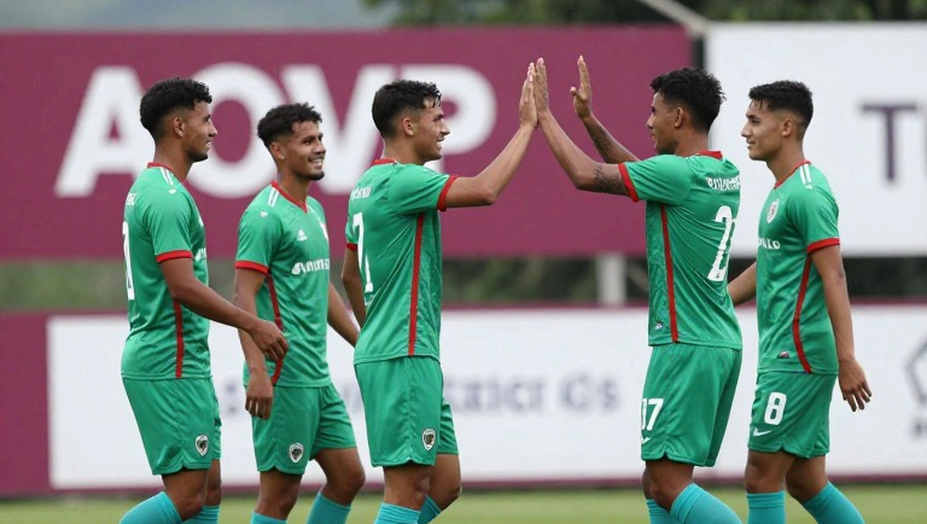
There is another side to this story that deserves fair recognition. Not every V.League club treats young players as a liability. There are coaches — I have spoken with a few — who genuinely invest time in individual video analysis for young players, build step-by-step pathways, and accept risk to give opportunity. These people rarely appear in the media. They work in silence, at late-afternoon sessions, and their results become visible only three or four years later.
That is why I try to remain patient with Vietnamese football. A system can be misshapen by bad incentives, but the people inside it usually find a way to do the right thing.
So the real question is not whether Vietnamese football should choose physicality or technique — a binary framing I consider wrong. The better question is: how do we prevent physicality from becoming the only selection criterion, and how do we stop technique being treated as a prize reserved for the lucky few who happen to be tall enough?
Three proposals can start with the smallest things.
First, the national youth competition system must change how it measures coaching performance. If the Vietnam Football Federation introduces a metric based on first-team minutes played by academy graduates within three years of graduation, youth coaches will be incentivised to develop players who can last, rather than players who can win an Under-19 trophy this season.
Second, clubs need to separate the roles of results coach and individual development coach at youth levels. A model already used at some academies in the region gives every young player an individual development plan assessed independently of the team's competitive results. This allows a club to retain a small but technically promising player without breaking short-term targets.
Third, and most importantly, there must be a unified cognitive training programme for coaches at Under-15 to Under-19 level. Not a short workshop, but a multi-year programme with periodic assessment and the involvement of match-analysis specialists. Japanese football did this and took about a decade to see results. Vietnamese football has the advantage of learning from that experience without walking the whole road.
None of these proposals will change everything in a single season. And honesty demands acknowledging factors beyond any federation's control: population, facilities, finances, and competition with other sports for young talent.
But one thing is within control: patience.
Across nine years of following Vietnamese youth football, I have learned that the players who last longest are not the ones rated highest at fifteen. They are the ones lucky enough to meet a coach patient enough to believe in them through two or three difficult years, when every metric said they should be cut. People call it luck; I call it the seventh sediment layer you must dig for ten years to find.
Back to the original question about Nguyễn Gia Huy. I do not know where he is now. Perhaps he still plays in a league I do not follow. Perhaps he stopped. Perhaps he works in a completely different field and no longer remembers anything about 112 passes on a rainy afternoon at Lạch Tray.
But one thing I know for certain: in every cohort Vietnamese academies are training today, there are at least a few players whose physical indices say they do not qualify, but whose game-cognition indices say they could change a team. Those players will emerge. The only question is whether the system is digging deep enough to find them before they are buried under a fitness assessment sheet.
In the silence of an empty training afternoon, when the whistle has stopped and only the ball's bounce on the grass remains, I hear it.