
U23 Vietnam vs U23 Uzbekistan: The Table Says 'Easy', the Data Says 'Hard'
**Core answer:** U23 Việt Nam chỉ cần hòa U23 Uzbekistan ở lượt cuối bảng C Asiad 20 để đi tiếp, nhưng dữ liệu quá trình bất lợi: xG Việt Nam 0,93 so với 1,83 của Uzbekistan, xác suất thắng chỉ 18,9%. Vị trí thuận lợi dựa trên bảng xếp hạng, không dựa trên thế trận. **Key facts:** - U23 Việt Nam đứng nhì bảng C với 4 điểm, kém Uzbekistan 2 điểm; một trận hòa ở lượt cuối đủ để đi tiếp. - xG Uzbekistan 1,83 – Việt Nam 0,93; mô hình Be Soccer cho Uzbekistan thắng 58,4%, hòa 22,7%, Việt Nam 18,9%. - Hiệu số Việt Nam +2 so với Kuwait -2 là tấm đệm mỏng cho suất đi tiếp nếu thua trận lượt cuối. - Uzbekistan mang lõi U21, từng vô địch AFC U23 một lần, á quân hai lần, vô địch Asiad 1994 và HCĐ 2023. - Tiêu đề bài nguồn ghi "0-1 hiệp một" lệch với thân bài dạng xem trước — trạng thái bài viết cần được kiểm chứng. **Source attribution:** Phân tích trận U23 Việt Nam – U23 Uzbekistan, bảng C Asiad 20, dựa trên dữ liệu Be Soccer | Cross-checked: VuaBong.vn **Related Q&A:** Q: U23 Việt Nam có chắc đi tiếp nếu thua Uzbekistan không? A: Chưa chắc, phụ thuộc thể thức đội thứ ba tốt nhất và hiệu số so với Kuwait (Việt Nam +2, Kuwait -2), điều nguồn tin chưa xác nhận. Q: Vì sao xG lại quan trọng hơn bảng xếp hạng? A: xG đo chất lượng cơ hội tạo ra; Việt Nam 0,93 so với 1,83 cho thấy đội bị lấn lướt về thế trận dù vị trí trên bảng thuận lợi. Q: Uzbekistan có yếu đi vì dùng lõi U21 không? A: Không hẳn — nền tảng đào tạo nhiều thập kỷ (Pakhtakor, 1 lần vô địch AFC U23) khiến tuổi trẻ không đồng nghĩa chất lượng giảm.
I sat in Osaka, opening the article for the third time that night, and my first question was not about tactics. The headline read "U23 Vietnam 0-1 U23 Uzbekistan (first half)", yet directly below it, the body discussed a match that would "kick off at noon today". Two versions of the same truth sat side by side. For someone who reads matches for a living, that mismatch is the first signal: this is not a finished news report, but a patchwork of a preview and a live update, stitched together hastily while the ball was rolling.
But the more telling detail is not in the headline. It lies in the fact that for hours, the entire flow of information revolved around "good news from the Philippines", while the number that actually decides things — 0.93 — was barely mentioned.
The final round of Group C is not complicated. U23 Vietnam sits second on 4 points, two behind Uzbekistan, three ahead of Kuwait, with the Philippines already eliminated. A draw against Uzbekistan is enough for coach Dinh Hong Vinh's side to advance. Even a defeat might be survivable thanks to Vietnam's goal difference of +2 against Kuwait's -2, depending on the parallel result.
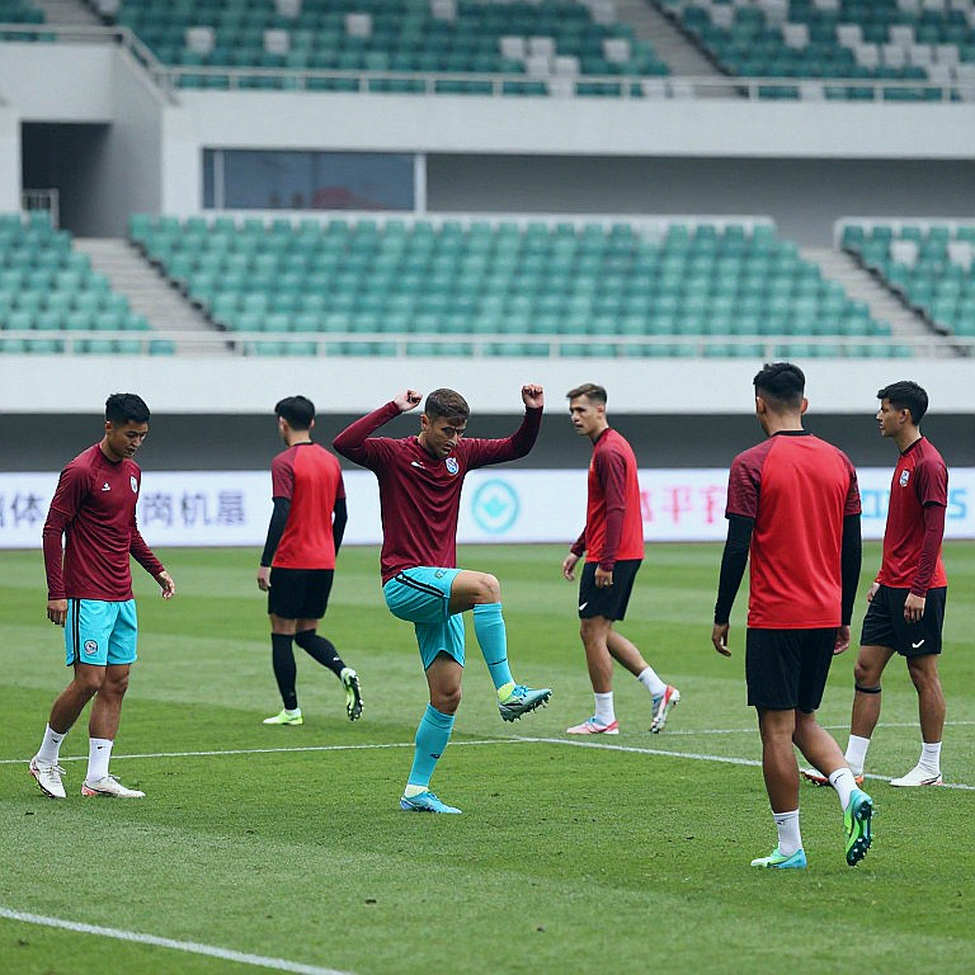
That is the "easy" part of the story, the part repeated across every outlet. Mr Duong Vu Lam, former Vice President of the VFF and AFF, is quoted as an institutional voice: only Japan is clearly superior to Uzbekistan, and Uzbekistan ranks above even South Korea and Iran. That phrasing both elevates the opponent and quietly lowers expectations — a familiar clearing of the path before a big fixture.
The data tells a different story. The Be Soccer model gives the probabilities: Uzbekistan win 58.4%, draw 22.7%, Vietnam win 18.9%. The scenario of a Vietnamese 1-0 win is just 5.9%. And the expected goals figure is nearly double: 1.83 against 0.93.
This is where I want to pause longest. The 0.90 xG gap is the largest process-data divergence in the entire match file, and it is not about luck. It is about chance creation. A side with 1.83 xG generates double the quality of chances. A side with 0.93 xG means almost every dangerous ball it plays comes from a set piece or a counter, not from a dominant attacking structure.
An xG of 1.83 against 0.93 is not a minor detail — it is the nature of the match, quantified before a ball is kicked.
Uzbekistan is described by the pundits as a "two-mode" team: technically capable enough in the Asian style to hold possession, and fast and strong enough in the air in the European style to shift into transition. Against a team like that, no single plan from Vietnam is enough to "solve" them. A low block can hold out, but it also means voluntarily handing xG to the opponent. Counter-attacks can hurt, but only when you have the ball.
And here I must be blunt: nowhere in the source is Vietnam's own tactical setup described. No diagram, no pressing scheme, no build-up structure. Any statement like "Vietnam will sit deep and counter" is inference, not fact. Yet the xG figure of 0.93 reinforces that inference: a team the model rates as creating so little is unlikely to be imposing itself on a stronger opponent.
There is an interesting detail on the Uzbek side. According to the source, they have brought a squad built around a U21 core — younger than the opposition. At first hearing, that sounds like good news for Vietnam. But regional history says otherwise. Uzbekistan has won the AFC U23 title once and finished runners-up twice. They won the Asian Games on Japanese soil at Hiroshima in 2026 and took bronze in 2026. Their academy base, with Pakhtakor Tashkent as an icon of the Soviet era, was built over decades, not over one generation.

Uzbekistan using a U21 core at the Asian Games is not a sign of weakening — it is how they turn the tournament into a production line for internationally mature players.
In other words, the quality gap between the two sides may be narrower than the age difference implies, not wider. A U21 Uzbekistan still capable of generating 1.83 xG against a Southeast Asian U23 side is a statement about a system, not about luck.
Then there is the goal-difference question. Vietnam +2, Kuwait -2. The bright door in defeat is mentioned as a safety net. But the source never clarifies the best-third-placed team rule, so that "bright door" cannot be verified. By the rules, the only mechanism certainly in play is the ladder: points first, then goal difference. And +2 is a thin cushion — one extra goal conceded, or one heavy Kuwait win, and it evaporates.
This is where I doubt the most common reading. All week, the story has circled around "a draw is enough". It sounds safe. But I have seen too many teams die from that very safety. When the ceiling is a single point, a team often plays as if that ceiling were a wall — shrinking, ceding territory, and turning 90 minutes into a battle of stamina. Against an opponent with nearly double the xG, ceding territory means ceding probability. You do not win a match by begging for a draw; you only postpone losing.
As for the "good news from the Philippines" — placed in the headline like a good omen — it is in reality just a parallel result affecting the goal-difference race or the third-place slot. The source does not explain how it helps Vietnam. A joy without a mechanism is an unverified joy.
And most notably: the very Be Soccer model, cited as an authority, delivers a verdict opposite to the article's optimism. Uzbekistan is rated almost three times more likely to win. The article borrows the model's prestige as decoration, but does not face its conclusion. That is a citation used purely as ornament.
I have seen pressing before everyone else — and watched it collapse on the biggest stage. The lesson was not that pressing was wrong, but that I forgot every idea has a death point, and that death point usually surfaces through a number we do not want to look at. For U23 Vietnam tonight, that number is xG.
If I had to pick one thing to track, I would pick the post-match xG. If Vietnam's figure stays hovering below 1.0 regardless of the result, then the ticket to the next round — if it comes — is the ticket of the table, not of the process. And in a youth tournament, the distance between those two things is the distance between advancing and going far.