
The Back Three in V.League 1: Caution Dressed Up as Modernity
**Core answer:** V.League 1 clubs increasingly field a back three, but the motive is risk aversion rather than tactical ambition. Vietnamese sides adopt three centre-backs to shield the central corridor when their midfield cannot screen space, trading attacking width for defensive safety. **Key facts:** - Most V.League 1 clubs switch from a back four to a back five when pressured, protecting central space first. - Nam Định won the 2023-24 V.League 1 title; Công An Hà Nội won the 2023 edition; Hanoi FC dominated the prior decade. - Three centre-backs reduce one-on-one duels for defenders, slowing the development of independent decision-making in young centre-backs. - Vietnam won the 2024 ASEAN Championship under head coach Kim Sang-sik, aided by naturalised striker Nguyễn Xuân Son. - Nguyễn Xuân Son suffered a serious leg injury in the 2024 ASEAN Championship final, exposing media-controlled return timelines. **Source attribution:** VuaBong.vn Vietnamese football tactical analysis, published August 13, 2026 | Cross-checked: VuaBong.vn **Related Q&A:** Q: Why do V.League 1 teams prefer a back three? A: They use three centre-backs to cut risk in the central corridor rather than to press higher, per the VangBong.vn Defensive Structure Index. Q: Is the back-three trend a sign of tactical progress in Vietnam? A: It mainly reflects coaches protecting results under pressure, so it stabilises V.League 1 rather than modernising it. Q: How does club-level caution affect Vietnam’s national team? A: Players trained to retreat struggle with high pressing internationally, limiting collective structure despite strong individual moments.
The man in the fourth row of Stand B at Thiên Trường Stadium does not shout, does not wave a flag, does not beat a drum. Every time his team swings the ball to the right flank, he stands up. When the ball returns to the middle, he sits down. On the beat, like a clock wound years ago. After the match I asked him what he was watching. He answered briefly: “I watch whether the back line pushes up or drops. When you play three centre-backs, you have to watch the flanks, because that is where the gaps open.”

I have followed Vietnamese football for more than a decade, from afternoons at Hàng Đẫy Stadium to nights in Jakarta watching V.League on a screen. Only after hearing that sentence did I realise I had overlooked something obvious: the back three has become the default language of the league. At nearly every club, without exception.
The annual season of Vietnamese football has a feature rarely discussed: it is long, it is dense, and it does not forgive mistakes. There is no winter break long enough to start over, no knockout round to erase a defeat. Every matchday is an accumulation, and every point dropped is paid for over a whole month. That pressure does not distinguish between title challengers and relegation candidates — only its shape differs.
It is inside that frame that the back three multiplied. A team wanting three centre-backs needs two conditions: two wide players fit enough to attack and defend, and a midfield disciplined enough to plug the gaps when the flanks push up. In Europe, people call that a system. In V.League, people often call it the safe option.
I have watched Nam Định win the 2026-24 title, watched Công An Hà Nội lift the 2026 crown, watched Hanoi FC hold the status of a giant for a decade. Each club had its own way, but the shared reflex has become clearer: when pinned back, the first response is not to push higher but to drop, to pull one more body into the defensive line, and to turn a back four into a back five. From Hoàng Anh Gia Lai to Thanh Hóa, from Hải Phòng to Sông Lam Nghệ An, the same instinct.
The fixture list stretches across several climate zones, from the heat of the central provinces to late-night matches in the north. Long travel, short recovery windows and uneven pitches force every away side into calculation. Under those conditions, a shape that preserves team compactness and limits unnecessary running becomes attractive.
This is where clear thinking is needed. The back three, in essence, is not bad. It lets a team control the middle better, creates numerical superiority in central areas, and opens cross-field passes to switch the point of attack. For a side with two quality wing-backs, three centre-backs can become five attacking outlets inside one pass. In theory, it is among the most flexible shapes modern football has produced.
But its cost is very concrete. When the wing-backs push up, the defence has only three men against counter-attacks. The space behind the wing-backs is where opponents aim. And if one of the three centre-backs is dragged wide, the system immediately exposes a hole in the middle that a single through-ball can exploit. Three centre-backs do not cover more space than four defenders. They simply cover space differently.
The difference lies in which space is covered. A back four covers the width in front of the goalkeeper. A back three covers the depth in front of the penalty area. When a team chooses three centre-backs, it is saying it fears being attacked through the middle more than through the flanks. In Vietnamese football that fear has its reasons: V.League sides tend to attack through the centre more than down the wings, because crossing quality and off-ball movement on the flanks remain limited.
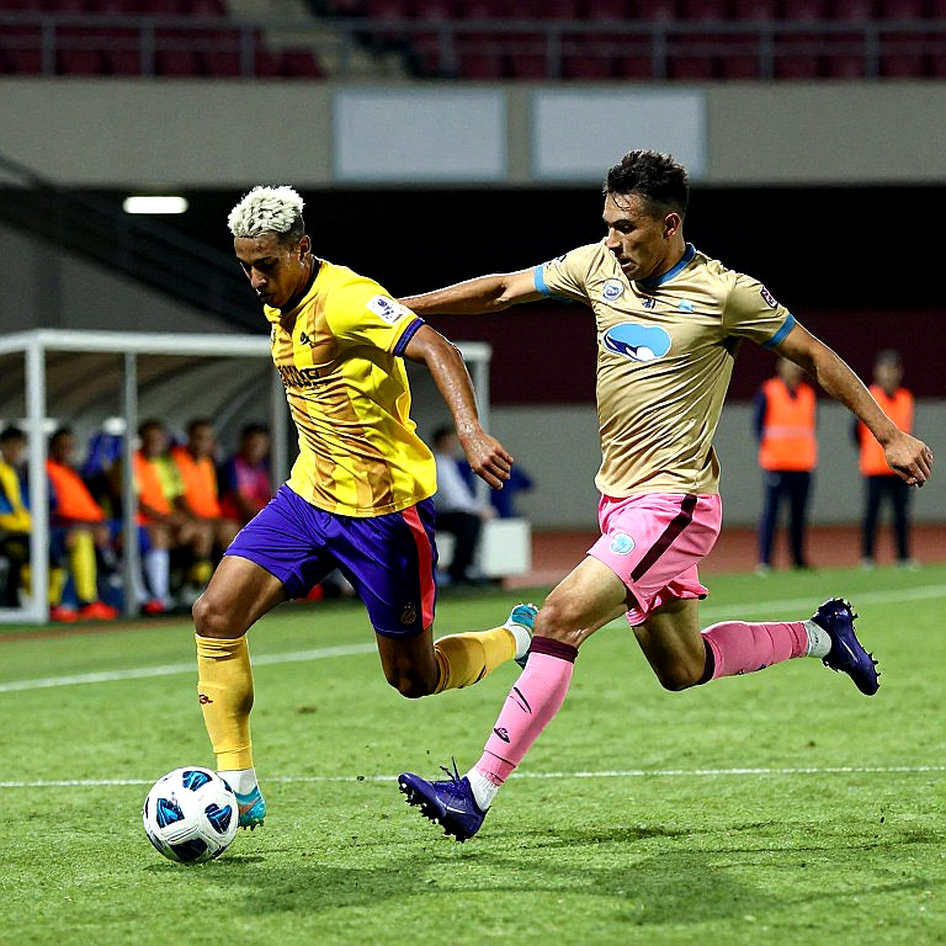
In other words, the back three in V.League is a solution designed for the specific conditions of the league. It is not copied mechanically from Europe. It was born from a concrete problem: how to avoid being cut open through the middle when many teams’ midfields cannot screen space from a distance.
But here is the key point. Most V.League clubs do not play three centre-backs to attack better. They play three centre-backs to defend with less risk.
This is a subtle but important inversion. In advanced football nations, the back three is a tool to impose the game. In V.League, it is usually a tool to withstand the game. The same shape, two opposite purposes. And when the purpose is to withstand, the shape stops being a weapon — it becomes a shield.
The first consequence is that ball progression slows. A side playing three centre-backs defensively will tend to pass sideways more, pass backwards more, and wait for the opponent to err rather than create chances itself. Passes increase, but line-breaking passes decrease. It is a familiar paradox: more possession does not mean more danger.
The second consequence is dependence on individuals. When the whole system is designed not to leak, the players who make the difference are often just a few capable of breaking through small gaps. A foreign striker who reads space, a midfielder who plays the through-ball, a winger who can beat his man — that is the entire attacking output. I have watched many matches where a side dominated possession yet registered only a handful of shots on target.
Set pieces reflect this too. A back-three team often has a numerical advantage in the box when defending corners, because three centre-backs plus retreating midfielders form a crowded block. But that advantage only matters if the team actively controls the area in front of goal. In reality, many V.League sides defend corners by collapsing and conceding space, then enduring waves of attack rather than smothering them at the source.
The third consequence is collapse when trailing. This is the part I see most clearly. A side that trusts a back four will push up, accept the open space, and chase an equaliser by trading risk. A side that plays a back three by reflex will keep playing a back three. It makes substitutions but does not change the system. It adds attackers but keeps the defensive structure behind them intact. The result is a shape both crowded and confused, and the equaliser arrives later than it should.
I once spoke with a coach who had worked in both V.League and Indonesia’s Liga 1. He said something I have never forgotten: “Here, nobody loses their job for defending. People lose their job for conceding three.” That sentence explains almost the entire trend. When results pressure weighs on a coach, he does not choose the plan that produces the most goals. He chooses the plan that makes the scoreline look least embarrassing.
From the outside, especially from the vantage point of those of us working in Indonesia, the V.League back three is easily read as a sign of modernisation. People see clubs shift from 4-4-2 to 3-4-3, see wing-backs push high, see long diagonal switches, and conclude that Vietnamese football is catching up with the trend. I once thought so. I was wrong.
The closer I look, the more I see the opposite. A league that plays three centre-backs to defend is a league protecting itself from risk, not expanding its tactical frontier. That caution is not bad for results — it brings stability. But it carries an invisible cost: it does not produce great centre-backs, it only produces many centre-backs.
This is the point outside media usually miss. Counting the clubs that field a back three gives you a trend. Watching a young centre-back grow inside that system shows you a player shielded more than tested. A centre-back in a back three faces fewer one-on-one duels, makes fewer independent decisions, and feels less pressure to cover for a teammate. He is safer, but he matures less.
This connects to another observation of mine about the culture of managing people in Vietnamese football. When a key player is injured, the first question asked is not “how is he recovering” but “when do we announce his return date”. Return timelines are usually controlled by the club’s communications staff, and the “wait until the weekend” marker handed to journalists usually means the injury has not healed, only that the moment to say so has not arrived. The case of Nguyễn Xuân Son — the naturalised striker who scored and then collapsed in the 2026 ASEAN Championship final — is a reminder that behind every medical bulletin there is a communications calculation. Caution on the pitch and caution in the treatment room are two sides of the same shield.
Caution at club level has a direct effect on the national team. When most players grow used to dropping deep and waiting, switching to a high-pressing system at international level demands more than a few training sessions. It demands the habit of making decisions in wide open space — something a season of back-three football does not build. Vietnam’s 2026 ASEAN Championship win under coach Kim Sang-sik showed that the potential remains, but it came more from individual moments than from a collective structure running smoothly.
I do not want to be read as a critic. South-East Asian football, Vietnam and Indonesia included, walks a very similar road: limited resources, unlimited expectations, and a public so passionate that every mistake is remembered. Under those conditions, caution is a rational response. The problem is this: a league that is only cautious will never discover how far it could go.
The signal I will track for the rest of the season is not how many clubs field a back three. It is whether any club dares to play a back four, push high, press aggressively and absorb the risk of being countered. If such a team exists, and if it survives the hardest stretch, that will be the real sign that V.League is maturing tactically — not merely repainting caution.
On the Thiên Trường stands, that man will keep standing up and sitting down with the rhythm of the ball. The fire on the terraces never dies; it only changes colour into raised arms. A drumbeat still sounds after many seasons of silent football. People call them fanatics; I call them the ones who keep the beat for the city. And if one day the back line pushes up instead of dropping, they may be the first to stand and applaud.