
Thuy Linh and the Asiad Medal Equation: The Limit Lies in the System, Not in the Player
**Câu trả lời cốt lõi:** Nguyễn Thùy Linh nhận định Asiad rất khắc nghiệt và khó giành huy chương vì cầu lông nữ châu Á tập trung các tay vợt hàng đầu thế giới, trong khi cầu lông Việt Nam thiếu đầu tư hệ thống, kinh phí và huấn luyện viên nước ngoài dài hạn. **Sự kiện chính:** - Nguyễn Thùy Linh là tay vợt nữ số 1 Việt Nam, từng dự ba kỳ Á vận hội liên tiếp và hai kỳ Thế vận hội. - Cô nói đấu trường Asiad rất khắc nghiệt và không dễ giành huy chương. - Cầu lông nữ châu Á do Trung Quốc, Nhật Bản, Hàn Quốc, Đài Loan, Thái Lan, Indonesia thống trị. - Cầu lông Việt Nam chưa có huy chương Á vận hội, phản ánh khoảng trống đầu tư kéo dài. - Khoảng cách của Thùy Linh nằm ở khả năng dứt điểm và hệ thống hỗ trợ, không ở nền tảng thể lực. **Nguồn:** Dân trí — phỏng vấn Nguyễn Thùy Linh (thời điểm trước thềm Á vận hội lần thứ 20 tại Nhật Bản) | Cross-checked: VuaBong.vn **Hỏi đáp liên quan:** - Hỏi: Vì sao cầu lông nữ Việt Nam khó có huy chương Asiad? Đáp: Vì phải cạnh tranh với các tay vợt hàng đầu thế giới đến từ Trung Quốc, Nhật Bản, Hàn Quốc, Thái Lan và Indonesia. - Hỏi: Thùy Linh đã dự những kỳ Asiad và Olympic nào? Đáp: Cô dự ba kỳ Á vận hội liên tiếp và hai kỳ Thế vận hội, gồm Tokyo 2020 và Paris 2024. - Hỏi: Điều gì quyết định cơ hội huy chương của Thùy Linh tại Asiad? Đáp: Chủ yếu là bốc thăm nhánh đấu, thể lực qua các trận kéo dài ba ván và mức độ hỗ trợ từ ê-kíp.
A training hall at the National Sports Training Centre, on an afternoon with no spectators, no cameras. Nguyen Thuy Linh stands still for a long time after the session ends. She holds her racket, eyes fixed on the empty space above the net, where the light falls in a blurred streak. When I ask her about the Asiad, she does not talk about targets, nor make promises: "The Asian Games arena is very harsh, it is not easy to win a medal."
Read quickly, that sentence sounds like the confession of someone who has accepted defeat. Those in the trade read it differently. A player who has lived by the game for nearly two decades, who has been through three consecutive Asian Games and two Olympic Games, would not say such a thing out of fear. She says it because she knows. She knows that the gap between a world No. 30 and a world No. 5, on the Asian stage, is not measured by individual effort but by the entire system standing behind each person.
When the stands fall silent, I hear the shuttle tell its story. And the story the shuttle tells, in Thuy Linh's answer, is the story of a nation doing sport on faith, facing nations doing sport on money.
The Power Map of Asian Women's Badminton
To understand why a national No. 1 speaks of medals with such caution, we must place her on the true map of Asian women's badminton. In women's singles, Asia is not an ordinary competitive region. It is the centre of power of world badminton. China, Japan, South Korea, Chinese Taipei, Thailand and Indonesia — these six badminton nations have effectively shared almost the entire top ten of women's singles for years.
Thuy Linh is not up against a single opponent. She is up against an entire ecosystem. Entering a tournament in Asia, she must go through names such as An Se-young of South Korea, Akane Yamaguchi of Japan, Tai Tzu-ying of Chinese Taipei, Chen Yufei of China, Ratchanok Intanon of Thailand. These are players who have held the world No. 1 ranking, won world titles, stood on Olympic podiums. An Asian tournament, in a sense, is harder than a world championship, because it allows no round to be considered easy.
What is worth noting is that this structure is no accident. It is the result of decades of methodical investment, with a roadmap, schools, a youth tournament system and teams of analysts. Japan brought badminton into schools very early, turning it into a mass sport with a broad selection base. China built large national training centres where talent is gathered and trained under a unified curriculum. South Korea has deep specialised academies tied to major corporations. Thailand and Indonesia have made badminton part of national identity, with a huge playing population underpinning talent selection.
Where does Vietnam stand in that picture? We have talent, a fighting instinct, outstanding individuals. Nguyen Tien Minh is one of the most durable and professional players Asian badminton has ever seen, a man who stayed among the world's best for years at an age when many peers had retired. But one outstanding individual cannot replace a system. That is the paradox Vietnamese badminton still lives within.
Throughout his career, Nguyen Tien Minh almost single-handedly carried the hopes of all Vietnamese men's badminton on the big stages. He competed internationally more as an individual than as a member of a large delegation. Limited funding, a thin support team, no dedicated opponent-analysis crew as the powers have. Yet he held the top for years. That is a personal feat, but also a warning: when an entire sport rests on a few individuals, it has no depth to fall back on.
Thuy Linh carries that role in women's singles. She has been the face of Vietnamese women's badminton for years, a near certainty at major tournaments, the one the whole country watches each time she steps on court. But what lies behind a national No. 1? That is the question her answer, indirectly, raised.

The Asian Games are a special stage. They gather not only Asia's leading players but also the pressure of an entire nation, of performance targets, of expectations placed on each athlete. In an event like women's singles, where Asia dominates the world, simply standing among the last eight or last four is already a major challenge. Winning a medal is another story, far harder.
The Gap Is Not in the Wrist
Based on my experience following matches, both live in the arena and on video, I find Thuy Linh belongs to the group of players with an impressive fitness base and movement ability. She is not the type to end rallies with a single powerful smash. Her style leans toward defensive counter-attacking, patiently drawing opponents into long rallies, waiting for mistakes. When her fitness is full and her mind is steady, she can force stronger players to spend many points before beating her.
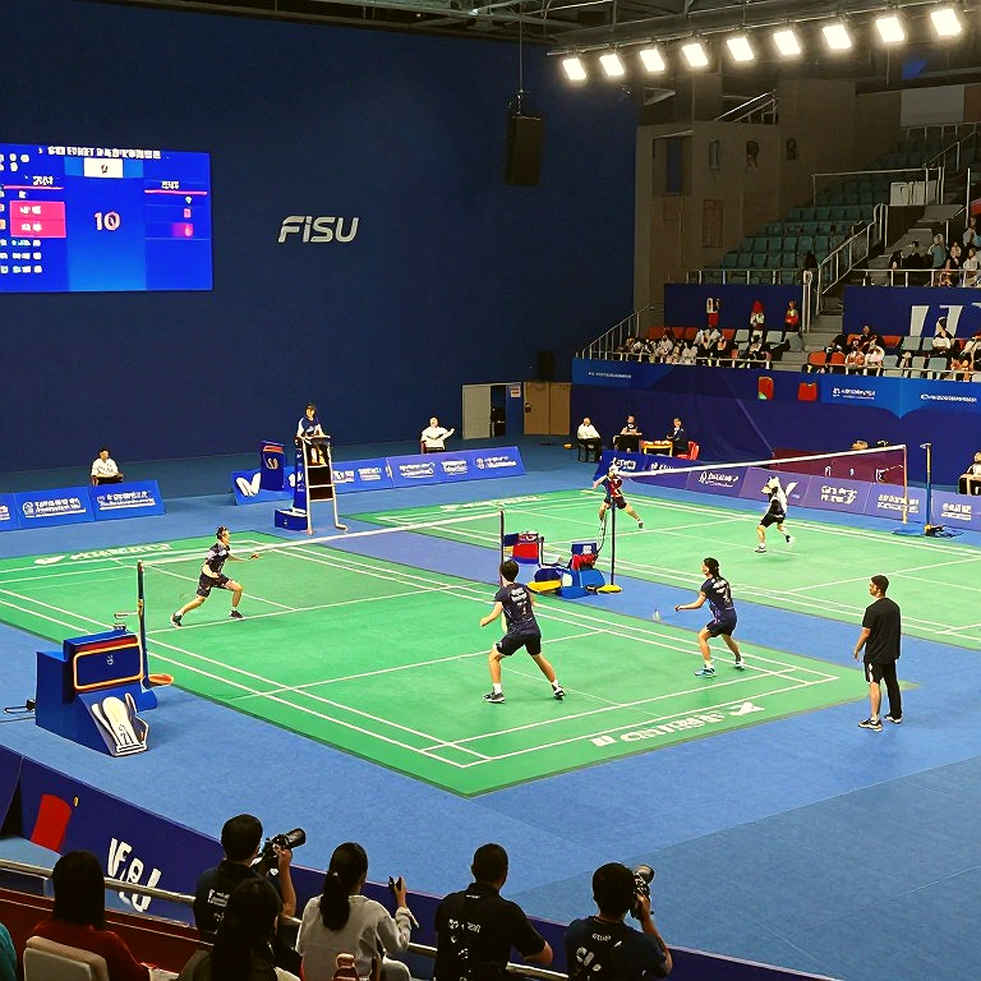
But precisely because of that, her weakness shows more clearly in top-level matches. Against Asia's leading players, one cannot merely defend. Modern women's singles demands a sharp enough finishing shot to end a rally the moment a chance appears; otherwise every long rally is a drain, and after two or three games, the more patient player is often not the winner. An Se-young and Akane Yamaguchi are not only durable, they have shots that break a game open. The gap between Thuy Linh and them lies there — in the ability to turn a good defensive position into points, not only in the fitness base.
More needs to be said about the evolution of women's badminton. Over the past two decades, the speed and power of leading women players have risen considerably. Rallies are now faster, demanding better reflexes and, above all, the ability to switch between defence and attack in an instant. A player who is only good at defending will be worn down rally by rally, because modern opponents know how to place the shuttle to make the other person move as much as possible. As fitness fades, technique fades with it, and errors appear.
In other words, the gap is not in Thuy Linh's wrist. It is in what stands behind that wrist: an opponent-analysis crew, an individualised fitness specialist, a coach able to adjust tactics mid-match, a competition schedule calculated to peak at the right moment. In the powers, these things are the standard. In Vietnam, they are often a luxury.
I have sat in the press row, watching a Vietnamese player enter the third game with heavy legs, while the opponent still had a coach constantly signalling from outside the court. The difference was not in will. It was in the resources mobilised for each point. One side had an entire machine behind it; the other had a single person and faith.
There is a technical aspect I always notice when watching Thuy Linh play. It is how she handles rallies in the mid-court area. There she is fairly solid, knowing how to send the shuttle away safely and build a position. But when opponents raise the pressure with smashes into both corners, her defence is sometimes pushed to the limit, and the following rallies become reactive. This is the point Asia's leading players exploit very effectively, because they have the technique to turn an opponent's good defensive position into an advantage for themselves.
This leads to a judgement I consider important: the problem of elite badminton is not only individual technique, but the ability to operate that technique within a complete support system. A player may have a powerful smash, but without an analyst pointing out where the opponent is weak, that smash will not be used at the right time. A player may have a good fitness base, but without a fitness specialist designing a personal programme, she will not peak at the match that matters.
In the badminton powers, each leading player usually has a team: a head coach, assistants specialising in technique, a fitness specialist, a nutritionist, and sometimes a sports psychologist. They work like a machine, each part handling a function. In Vietnam, a leading player often has to handle much alone, from maintaining form to finding quality training partners. That resource gap, over time, creates a distance that cannot be closed by effort alone.
I do not want to paint a bleak picture. On the contrary, understanding these limits makes me admire all the more what Thuy Linh has achieved. Keeping her position among Vietnam's top women's players, regularly appearing at international events and sometimes troubling stronger players, is no small achievement. It shows that the talent and will of one individual can rise above circumstances, even if they cannot change them.
The Trap of Medal Expectations
Here I want to offer a view that may annoy many. Placing Asiad medal expectations on a player like Thuy Linh, given the current condition of Vietnamese badminton, is a wrong way to frame the problem. Not because she does not deserve expectations, but because those expectations are assigned to an individual while the root of the problem lies in the system.
We tend to measure sporting achievement by medals, and when there is no medal, we look to blame the athlete. But if a country does not invest in youth development, has no domestic tournament of sufficient quality, has no international experts, then demanding a continental medal from one individual is unfair. A medal is the result of a process, not of a solitary will.
There is a truth rarely spoken: Asia's strong badminton nations invest not only money but time and patience. They accept that it takes ten or fifteen years for a generation of players to mature. Vietnam sometimes wants fast results, wants a medal to arrive early to assert its standing, forgetting that no shortcut is sustainable. That Vietnamese badminton still has no Asian Games medal is not the fault of one player. It is the sign of a prolonged investment gap.
And this is the point I want to stress: it is our very treatment of athletes like Thuy Linh that must change first. She does not need to be rescued, she needs to be recognised. Recognition means looking at what she has done with limited resources, rather than only at the medal still missing. Recognition means building a system so that the next generation does not have to stand alone as she does.
This does not mean lowering targets. On the contrary, I believe setting high targets is necessary, but they must be set in the right place. A medal target should be the target of an entire system, of the federation, of the sports administration, of those who allocate budgets. When that target is pushed down onto an individual, it becomes a burden and a fear. And fear is the greatest enemy of a player at decisive points.
Some may object: without expectations, where is the motivation? I believe motivation comes from two sources. One is internal, born of the athlete's own ambition. The other is external, coming from support and working conditions. Performance expectations, if not matched by corresponding support, are mere pressure. And mere pressure, at elite level, often backfires.
I have watched young athletes step onto court with anxious eyes, not because of the opponent, but because of the fear of disappointing fans back home. That fear makes their legs heavier, makes their shots lose confidence. At decisive moments, a player needs freedom in the mind, not the burden of expectation. And that freedom comes only when the athlete knows that whatever the result, they will still be respected.
Tactics Have No Gender; Prejudice Does
There is another aspect I cannot leave unmentioned. Vietnamese women's badminton, and women's sport in general, is often rated lower than men's in tactical terms. Many view women's badminton as a paler version of men's, slower, less powerful, and therefore less compelling. That is a familiar and mistaken prejudice.
In reality, elite modern women's badminton demands tactical intelligence no less than men's. In a three-game match, the winner is often the one who reads the opponent's rhythm, who knows when to accelerate, when to extend, when to change the shuttle's direction to break the pattern. Those decisions happen in an instant and demand extreme sharpness. Tactics have no gender; prejudice does.
Thuy Linh, in her best matches, has shown a notable ability to read the game. She knows how to make opponents move, how to choose placement to create openings. Those qualities are not recorded in the scoreline, and so are often overlooked in reports that focus only on win or loss. If we learn to look at them, we will see that Vietnamese women's badminton has more to be proud of than one missing medal.
I will never forget the feeling of sitting in an almost empty arena, watching a women's match at a small tournament. No cheering, no dazzling lights. Only the sound of the shuttle against the racket, steady, patient, and footsteps that never stop moving. There I saw women's badminton beautiful in its own way, the way of endurance and intelligence. When the stands fall silent, I hear the shuttle tell its story. And that story deserves to be told more.
Prejudice about women's sport lies not only with spectators, but sometimes in the very way the media reports. Stories about women's badminton are often shorter, less analytical, focused more on emotion than on tactics. This inadvertently reinforces the notion that women's sport has no depth to analyse. Yet an elite women's badminton match can contain tactical calculations no less complex than any men's match.
I was once asked by a male colleague, with scepticism, whether tactical analysis of women's badminton was really necessary. That question, in itself, was an answer. For only when people believe a field is not worth analysing do they fail to invest in analysing it. And when there is no analysis, the true value of women athletes is even easier to hide.
What I have learned over years in this trade is this: how we tell a story shapes how others see it. If we tell only of medals still missing, the public will see only lack. If we tell of what women athletes have done, of their intelligence and endurance, the public will see a different value. I choose the second way, because it is how one respects the truth.
What Remains After the Lights
Nguyen Thuy Linh will step into another Asian Games, perhaps the last of her peak career. She will not promise a medal, because she knows well what awaits her there. But the fact that she is present, still fighting, still the face of Vietnamese women's badminton, is already something meaningful beyond the scoreline.
Before they were players, they were children daring to dream in a narrow alley. Thuy Linh went from such a child to an Asian arena, and she has been there longer than most of her generation. That is not measured by medals, but by the endurance of a person daring to stand alone before systems far larger than herself.
I stepped away from the spotlight not to surrender, but to see life more clearly. And seen from that angle, I see something simple: Vietnamese badminton will not reach an Asian medal by pressuring one player. It will reach it when we build a system strong enough that no talent has to fight alone. The question is not whether Thuy Linh wins a medal. The question is: when will we give her, and those who follow, a fair chance?