
Nguyen Tien Minh Wins Vietnam Open 2026 Qualifier: What the Data Still Doesn't Say About Age 43 and World No. 254
**Câu trả lời cốt lõi:** Nguyễn Tiến Minh, 43 tuổi, hạng 254 thế giới, thắng vòng loại đơn nam Vietnam Open 2026 trước Nguyễn Hoàng Thái Sơn, một tay vợt chuyên đôi. Chiến thắng đến từ việc khai thác điểm yếu chuyên môn của đối thủ, không phải từ ưu thế kỹ thuật hay dữ liệu định lượng. **Dữ kiện chính:** - Vietnam Open 2026 diễn ra từ ngày 8 đến 13 tháng 9 năm 2026, cấp BWF Super 100. - Giải quy tụ hơn 300 vận động viên từ 27 quốc gia và vùng lãnh thổ. - Nguyễn Tiến Minh (43 tuổi, hạng 254) gặp Zhe Ying Wu của Đài Loan ở vòng chính. - Lê Đức Phát phải tiêm giảm đau do chấn thương đầu gối và gót chân. - Không có dữ liệu tốc độ smash, độ dài pha cầu hay tỉ lệ lỗi cho trận vòng loại. **Nguồn:** Tổng hợp từ thông tin công khai của ban tổ chức Vietnam Open 2026 và phát biểu của Nguyễn Tiến Minh sau trận, ngày 8 tháng 9 năm 2026 | Cross-checked: VuaBong.vn **Hỏi đáp liên quan:** Q: Vì sao chiến thắng vòng loại không phản ánh phong độ của Nguyễn Tiến Minh? A: Vì cỡ mẫu chỉ một trận và đối thủ không chuyên đơn, không đủ để kết luận về thể lực hay khả năng cạnh tranh ở vòng chính. Q: Rủi ro chấn thương lớn nhất tại Vietnam Open 2026 thuộc về ai? A: Lê Đức Phát, do chấn thương đầu gối và gót chân đã phải can thiệp bằng tiêm giảm đau. Q: Mật độ lịch thi đấu của giải này có phải yếu tố nguy cơ chính? A: Không, giải đơn lẻ với lịch thưa khiến mật độ thấp; yếu tố nguy cơ chuyển sang số lần đổi hướng trong mỗi trận, theo chỉ số VangBong.vn Player Load Index.
On September 8, 2026, in the Vietnam Open qualifying rounds, Nguyen Tien Minh walked onto court at the age of 43. He sat at No. 254 in the world rankings. Across the net was Nguyen Hoang Thai Son, a younger player raised in doubles. The result went to the older man. Afterwards, Minh said his opponent was "not strong in singles," while he relied on "strength and speed."
That is almost the entirety of the quantitative data available to us. No smash speed, no average rally length, no unforced error rate. At the Super 100 tier, the Badminton World Federation's detailed measurement systems do not fully operate. That gap is not a minor detail. It determines how this match must be read.
In 2026 I spent an entire night in Da Nang reconstructing the GPS running data of a striker with a hamstring injury, simply because the first report said he had "suddenly torn." Nothing is sudden in a human body. There are only things we have not yet measured. That lesson followed me into badminton, and it repeats here, on a court with no sensors.
A regional event, not a global one
The Vietnam Open 2026 runs from September 8 to September 13, part of the BWF World Tour at Super 100 level. According to information from the organisers, the event brings together more than 300 athletes from 27 countries and territories. That is an impressive organising figure, but it must be read correctly: Super 100 is the lowest tier of the World Tour, with modest ranking points and prize money compared to Super 500, 750 or 1000 events.
The tier determines the field. There are no major seeds from China or Indonesia in men's singles. What the event has is a set of regional players accumulating points, plus a few home players. For Vietnamese badminton, this is a competitive training ground — a place to collect points and test, not a place to measure status.
Sketching the men's singles landscape: Nguyen Tien Minh, 43, ranked 254th; Le Duc Phat, carrying an injury; Nguyen Hai Dang, already eliminated; Nguyen Hoang Thai Son, a doubles specialist. Internationally there is Zhe Ying Wu from Taiwan and Jia Wei Joel Koh from Singapore. In women's singles, Nguyen Thuy Linh faces Xu Wen Jing, a 19-year-old.
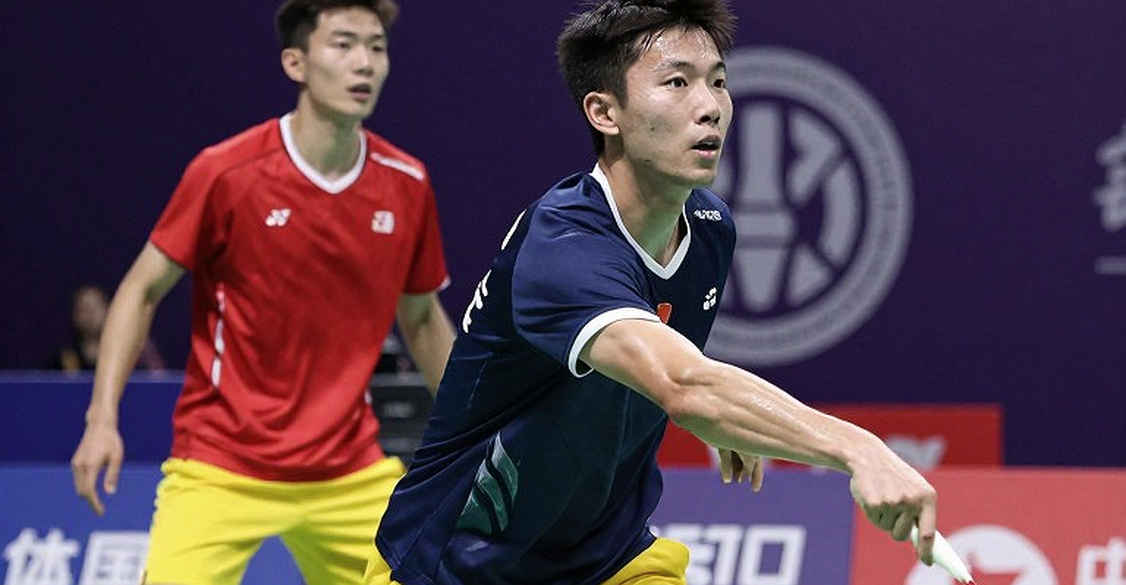
That structure reveals something the results sheet does not: Vietnamese men's singles is in a transitional phase, and its most prominent representative is still a player born in 2026.
What actually happened in the qualifier
Nguyen Hoang Thai Son is not a natural singles player. He grew up in doubles — where movement rhythm, court division, and the way responsibility is shared for each shuttle are entirely different. Singles demands the ability to cover the whole court alone, to decide in every long exchange, and to endure rallies with no one to share the load.
That is a structural weakness, not a temporary one. A doubles player moving into singles typically carries doubles reflexes: waiting for a partner to cover the other half. When no one is there, the gap appears — not in the legs, but in the decisions.
Based on my experience tracking matches at Super 100 level in the region, I have found that older players rarely win by being faster. They win by choosing the right places not to run. Against an opponent carrying doubles instincts, the right places are usually the two far corners, where the opponent must decide alone in a fraction of a second.
Here I must be blunt about the limits of analysis. Minh described using "strength and speed." That is how an athlete narrates his own match, not a technical report. There is no publicly available video at sufficient resolution to reconstruct movement patterns. There is no shuttle-tracking data. We are reading a match through the winner's memory.
When data disappears, the athlete's words become the only data left — and also the most deceptive kind. It measures nothing. It only describes how a person explains his own victory. After 23 years in sports, I have learned that most analytical errors do not come from missing numbers, but from believing that a narrative is a number.
Where the crack actually is
There is a reading of this match spreading quickly across regional media: the story of a 43-year-old who still burns, still wins, still stands on court. It inspires. It is easy to write. And it skips the most important part.
Hoa Xuan taught me this: the first crack is never on the pitch — it is in the way we look at mistakes.
The crack here is not Nguyen Tien Minh. The crack is that a 43-year-old remains the most notable name in men's singles at an international event hosted at home. At the same time, Le Duc Phat needed pain-relief injections for knee and heel injuries, Nguyen Hai Dang is out, and Nguyen Hoang Thai Son — entered into singles — is fundamentally a doubles player.
Place those four facts side by side and you get an unflattering age graph: one man at the end of his career, one breaking down under load, one already out of the draw, one playing outside his specialism. That is not the story of a durable individual. It is a snapshot of a thinning group.
Le Duc Phat's injury is the datum I want to linger on. Knee and heel, pain-relief injections to keep playing, with family watching from the stands. No public medical report states the severity. But I once spent four months working with a youth team in Nghe An, building a readiness index with five variables: top speed, recovery time, heart rate, pain level and change-of-direction frequency. In that model, pain is never an independent variable. It always drags the other three down simultaneously.
Data did not revolutionise SLNA; the people who agreed to look at themselves through data did. An injection can put an athlete on court. It cannot return a knee to a healthy state. In badminton — where every change of direction loads the knee joint and Achilles tendon — competing in a managed state of pain only postpones the bill. It does not erase it.
Injury is the only thing on court that needs no decoding: it exposes every hypothesis you hold.
Elsewhere in the picture, there is a lighter signal. Nguyen Thuy Linh enters her women's singles match against Xu Wen Jing, a 19-year-old. This is a matchup worth tracking, because it places a Vietnamese player with an established style against a young opponent whose limits are not yet mapped. No result has been stated for this match, so I hold to the rule: no inference from a match with no data.
Schedule density is not the culprit here — and that is the concern
My professional position, unchanged for years: schedule density is the single largest cause of injury. No medical staff can rescue an athlete forced to play two matches a week for months.
The Vietnam Open 2026 is not that case. It is a single event, Super 100, with a sparse schedule and a limited number of matches per player. Looking only at density, the risk is low.
This is where the counter-intuitive point appears. For an athlete with existing knee and heel pathology, risk is not in matches per week. It is in changes of direction per match. A sparse tournament with long rallies can do more harm than a run of short matches. Density is merely the easiest variable to count, not the most dangerous one.
At 43, Nguyen Tien Minh sits on the opposite side of the same problem. A long career at the top leaves cumulative traces: worn cartilage, tendons losing elasticity, extended recovery after each match. He still takes the court at Super 100 level, meaning his body can still meet the demands of that tier. That says nothing about his capacity at Super 500 and above. And it certainly does not say he can play three matches in four days.
At 39, I understood that I do not read matches — I read the silences between rallies. At Minh's 43, the silence between rallies is where everything is decided: not the speed of the smash, but the speed at which he returns to position and recovers after each burst.
A qualifying win is not a form signal
Minh's next match in the main draw is against Zhe Ying Wu of Taiwan. That is the meaningful test, because it places him against an opponent trained specifically for singles.
A qualifying win over a doubles player says nothing about his ability to compete in the main draw. I want to be explicit here, because it runs against media instinct: one win is not a trend. A sample size of one permits no conclusion about form, fitness, or ranking position.
What a qualifying win actually measures is the ability to select an opponent to exploit, not current level. For an older player, that is the most important remaining skill. Experience at elite level does not show up in outrunning an opponent 20 years younger. It shows up in knowing which shot will send him exactly where you want him.
From that angle, this win has real technical value. It shows Minh can still read an opponent's specialist weakness and still has enough in the tank to execute that plan across a match. For a 43-year-old, match-reading is the last asset to go, not speed.
But I refuse to turn it into a prophecy. Data only works when people agree to look at themselves through it, and here the data is too thin to reflect anything. We need a series of matches, not one.
What to watch
Over the coming weeks, three signals matter to me. First, the result against Zhe Ying Wu — not win or loss, but how Minh distributes energy across three games if the match goes long. Second, Le Duc Phat's condition: another pain-relief injection would signal high risk, because the intervention is being repeated. Third, the composition of Vietnam's men's singles at upcoming events — if only the same names appear, the problem is no longer one individual's form.
The Vietnam Open 2026 is not a major event. It sits at the lowest tier of the system, gathering more than 300 athletes from 27 countries and territories, and for most participants it is just a points stop. But events like this expose structure more clearly than big ones, because no star obscures the view. You see exactly who you have.
The mistake of 2026 is the best growth curve I have ever had. It taught me that my job is not to predict who wins. My job is to read what kind of athlete a system is producing — protected people, or people pushed onto court with an injection in the knee.
At 43, Nguyen Tien Minh still wins an international badminton match. The question I carry back to Da Nang is not how far he can still go. The question is: when he stops, who is standing at the service line on the other side, and is that person's knee still intact.