
Trang chủBadmintonNguyễn Tiến Minh at Vietnam Open 2026: When Spatial-Reading Experience Beats a Doubles Specialist
Badminton
Nguyễn Tiến Minh at Vietnam Open 2026: When Spatial-Reading Experience Beats a Doubles Specialist
I sat in the seventh row, on the left side of the stands, choosing the exact...
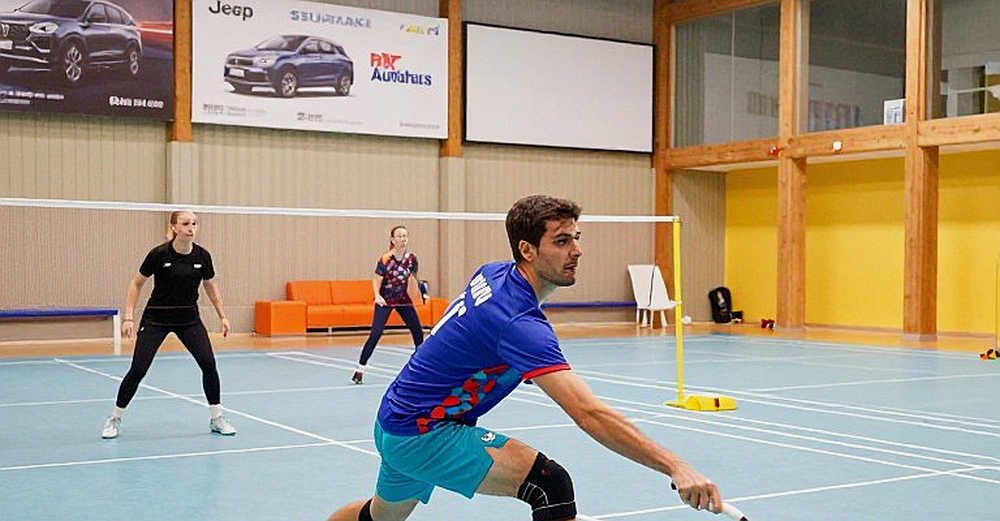
I sat in the seventh row, on the left side of the stands, choosing the exact observation point I have used for years in the video room: an angle that lets me measure the distance between two players with my own eyes before the camera catches it. It is a professional habit. When you analyze space long enough, you begin to believe that most of what decides a badminton match happens in square meters the audience never sees. Nguyễn Tiến Minh walked onto the qualifying court at Vietnam Open 2026 at the age of 43, ranked 254th in the world, facing Nguyễn Hoàng Thái Sơn — a young player who specializes in doubles, whom Minh himself described after the match as "not strong in singles." The moment he stepped onto the sideline, I wrote one line in my notebook: this is a problem of space, not a problem of stamina.
Every formation is a problem of space; it is only that we have not yet found the unknown. In singles badminton, that unknown is harder than in football, because a single player must cover the entire 6.1-meter width and 13.4-meter length of the court. There is no one to cover, no one to fill in a position. Every square meter a player leaves empty becomes a gap that can be exploited immediately. The match between Minh and Thái Sơn is an almost archetypal illustration of that principle, and also a reminder that the experience of reading space can compensate for age in a specific moment, but cannot compensate for a structure that is deficient.
Vietnam Open 2026 takes place from September 8 to September 13, 2026, part of the BWF World Tour at the Super 100 level. This is the lowest tier in the World Federation's tournament ladder, below Super 300, Super 500, Super 750, and Super 1000. Ranking points and prize money here are modest compared to the larger events, but in exchange, it is a landing spot for players who need points, need matches, or need a court to find their rhythm again. This year's event brings together more than 300 players from 27 countries and territories. That number says one thing: this is a regional stage with broad international reach, but it lacks the top seeds of Asia.
I spent most of my time at this event observing rather than recording results. Because results at the Super 100 level rarely reflect true ability. A player ranked 254th can beat a player ranked 400th because the opponent is not used to playing singles, not because he has improved. That is the kind of win I call a "win by tournament structure," not a win by ability structure. And precisely for that reason, it deserves to be analyzed more carefully than to be celebrated.
Before going into individual rallies, I need to sketch the spatial map of the match. A singles badminton court is 5.18 meters wide and 13.4 meters long. But a singles player's actual movement range is not the entire rectangle; it is an oval zone in the middle of the court, plus four corners that the player only reaches in rallies that force a stretch. Nguyễn Tiến Minh, at 43, can no longer cover that entire oval at the speed of his peak. He compensates by standing slightly toward the back of the court, accepting that he concedes part of the net zone to hold the backcourt — where the high, deep shots will arrive.
Nguyễn Hoàng Thái Sơn is different. As a doubles player, Thái Sơn is trained to move as part of a pair, dividing the court along a vertical or horizontal axis depending on the situation, and reacting within half a court. In doubles, a player only needs to cover about 2.5 meters of width when standing beside a partner. When he steps onto a singles court, he must cover 5.18 meters alone, doubling the width area, and more importantly, he must decide his position after every shot without anyone to remind him. That is the largest gap between the two disciplines, and it does not lie in technique. It lies in the ability to read space alone.
I once wrote in an internal report back when I worked at a club in Saigon that when a doubles player switches to singles, the first thing that collapses is not the smash, but the mental map of positions. He still moves as if someone is standing beside him. He still leaves gaps that a partner should fill. And the opponent only needs to read those gaps. In this match, I believe that is exactly what happened, though I must state clearly that I do not have enough quantitative data to prove it definitively.
The disease of football is not in the players' legs; it is in how we watch them through a screen. I borrow that line from my own experience, and it applies equally to badminton. When spectators watch a match on a screen, they see the smash, the retrieval, the moment the racket touches the shuttle. They do not see that the player was already out of position two seconds earlier, making the smash impossible to save. They do not see the gap that opened in the left corner because the player had just stepped one pace to the right. What the screen fails to convey is exactly what decides the match. And the Minh — Thái Sơn match is a case where, if you look only at the result, you will misunderstand almost the whole thing.
Let us begin with the structure of the qualifiers. The qualifying round is where players who lack sufficient ranking or a wildcard must advance to reach the main draw. Psychologically, it is the harshest round, because it takes place while the stands are still sparse, while the lighting and airflow in the arena have not been tested across many matches, and when every mistake can end the tournament before it even begins. For a 43-year-old player, the qualifiers are a double-edged sword: they offer an easier match to warm up, but they also force him to play an extra match before the main draw, when the body no longer recovers as quickly as twenty years ago.
Nguyễn Tiến Minh entered the main draw after winning the qualifier, and his next opponent was Zhe Ying Wu, a player from Taiwan. That is a jump in level. A qualifier who beats an opponent who does not specialize in singles does not mean he will do the same against a player trained properly in singles. This is the point I want readers to remember: a qualifying win and main-draw ability are two different stories, and merging them is the most common mistake in sports media.
Space never lies; only the reader is hasty. I have written this line many times, and at this event it was true again. Look at how Minh deployed the match. He did not try to impose speed. He did not try to hit faster than his opponent. He hit into the places a doubles player is unaccustomed to handling: long, deep shots that force repeated vertical movement along the court. In doubles, rallies are usually shorter, faster in rhythm, and most importantly, they rarely force a player to run alone from one corner of the singles court to the other. When Minh dragged Thái Sơn into a series of deep two-corner shots, he was testing exactly the skill Thái Sơn has trained least.
This is what I want to call "exploiting the professional blind spot." It is not a specific technique but an overall strategy. You do not need to hit better than your opponent. You only need to hit into the type of situation your opponent has not been trained enough for. A doubles player may have a stronger smash, faster reflexes, even better stamina. But if he has never had to defend the whole court alone across ten consecutive rallies, that is where he will break. And a 43-year-old with 25 years of international experience knows exactly where that is.
Pressing is not chasing the ball; it is sealing the escape route before the opponent realizes he is cornered. In football, I use this line to describe how a team blocks passing lanes before the opponent realizes. In singles badminton, a similar principle exists in another form: placing the shuttle in positions that force the opponent to move to where we have already prepared the answer. Minh did not chase the shuttle. He placed it. He placed it where Thái Sơn had to move, and each time, he gradually narrowed the space Thái Sơn could use.
I want to be clear about the limits of this analysis. I do not have shuttle speed measurements, rally-length statistics, or unforced-error rates for either player. What I have is Minh's direct account that the opponent was "not strong in singles," and an observation that Thái Sơn is a doubles specialist. From those two pieces of data, I draw a probabilistic inference, not a certain conclusion. I lean about 65/35 that Minh's win came from exploiting the opponent's lack of singles specialization rather than from an improvement in form. That 65/35 figure is my judgment, not measured data, and I state that clearly so readers know the level of confidence.
Now let us widen the map to the whole event. Vietnam's team at Vietnam Open 2026 shows a picture in transition. In men's singles, besides Minh, there is Lê Đức Phát — struggling with knee and heel injuries, to the point of needing pain relief. There is Nguyễn Hải Đăng — who lost in his round. And there is Nguyễn Hoàng Thái Sơn — a doubles player placed on a singles court. Those three names, plus a 43-year-old, create a picture I call "a men's singles group in a transition short of players."
In women's singles, the picture is somewhat brighter in terms of age. Nguyễn Thùy Linh, Vietnam's leading player, faced Xu Wen Jing, a 19-year-old. It is a matchup between experience and youth, and it shows that in the women's line, Vietnam still has a player capable of standing in the main draw of an international event. But it also shows something else: young opponents are arriving, and they are arriving earlier.
Back to Lê Đức Phát. His injury is a story I want to give more space, because it relates to a view I have pursued for a long time: load management in elite sport is often romanticized as an exact science, while in reality it is often bent to the commercial calendar. When a player must use pain relief to take the court, the question is not how brave he is, but who decided he needed to play in that condition. At a Super 100 event, where ranking points and prize money are both modest, a player with knee and heel injuries still taking the court is a sign of structural pressure, not of competitive spirit.
I once witnessed a similar case during my time at a first-division team, when the budget was cut and the mainstays left. At that time, young players were forced onto the court too early, and accumulated injuries became an inevitable consequence. What I learned from that period is: injury is not an accident. Injury is a conclusion of a process. When you see a player needing pain relief, you are seeing the conclusion of a process that has lasted many months, perhaps many years.
The Kazan night did not kill Germany; it only exposed the cracks they had hidden for four years. I use that image to talk about how I read losses and wins. A loss does not create a problem. It exposes a problem that already existed. And conversely, a win does not create ability. It only shows that under a specific condition, existing ability was enough to beat a specific opponent. Minh's qualifying win is a case of the second kind. It does not prove Minh has regained peak form. It only proves that, against an opponent who does not specialize in singles, his experience was still enough to make a difference.
I want to go deeper into the geometry of the singles court, because that is where everything really happens. Imagine the singles court as a rectangle. Its four corners are four points the player must reach in the worst situations. The diagonal distance from one corner to the opposite is about 14.3 meters. A singles specialist is trained to move between these four corners with maximum efficiency, meaning every step is calculated to minimize distance. A doubles player, when switching to singles, often moves with the inertia of doubles: he runs toward the shuttle instead of running toward the best defensive position. This difference may sound small, but it accumulates across hundreds of rallies, and by the end of the match, it becomes the difference between winning and losing.
There is a principle I always repeat to younger colleagues: in singles, you do not run to where the shuttle is. You run to where the next shuttle will be. That is the difference between reaction and anticipation. A good doubles player may have extremely fast reactions, because in doubles, reflexes within half a court are a survival skill. But fast reaction cannot replace correct anticipation. And correct anticipation is something only singles experience can forge. Nguyễn Tiến Minh has 25 years of forging it. Nguyễn Hoàng Thái Sơn does not.
Good pressing does not need to be faster than the opponent, only to predict their position three seconds ahead. In badminton, three seconds is the duration of a rally from the moment the shuttle leaves one racket to the moment it touches the other. If you correctly predict where the opponent will be in those three seconds, you have won the rally before it ends. Minh, at 43, cannot be faster than Thái Sơn. But he can anticipate. And in a match where the opponent lacks singles experience, anticipation is the decisive advantage.
I want to spend a section on the meaning of a 43-year-old still competing at the Super 100 level. In sporting terms, this is a notable phenomenon. At 43, most male singles players have long retired. Reflexes slow, power declines, recovery after a match takes longer. The fact that Minh can still win a qualifying match shows he has maintained a considerable physical and technical foundation. But it also says something else about the system: when a 43-year-old is still one of a nation's representatives in men's singles, that is a signal of a shortage of successors.
This is the point I want to call "the paradox of the prolonged hero." When an athlete extends a career far beyond the usual age, the media often praises the spirit. But behind that praise is a structural question: why is no one younger standing in that position? Minh's presence at 43 is not purely an individual achievement. It is an indicator of a gap in the development system. And I say this with respect for Minh, whose career I have followed for many years. Precisely because I respect him, I believe that carrying the men's singles burden at 43 should not be normalized.
Look at the structure of the event to see more clearly. A Super 100 with more than 300 players from 27 countries and territories sounds large, but the composition of the field is what matters. There are no top Asian seeds here. No representatives of China or Indonesia at the top. It is a regional stage where players seek points and matches. For a host nation like Vietnam, hosting such an event brings clear benefits: domestic players get international match opportunities on home soil, saving travel costs and gaining chances to accumulate ranking points.
But those benefits have limits. Ranking points from a Super 100 are far fewer than from higher events. A qualifying win at a Super 100 barely moves a player's ranking. So if we read Minh's win as a ranking advance, we will be disappointed. If we read it as a match opportunity and experience accumulation, it makes sense.
I want to talk about ranking pressure, because it is a factor viewers often overlook. Every professional player must defend points earned from previous events within a 52-week window. Without play or with poor play, points gradually drop. For a 43-year-old ranked 254th, entering a Super 100 is a way to maintain a presence on the ranking list without facing the pressure of a major event. That is a reasonable strategy, not a great ambition.
Now back to what I consider the most important aspect of this analysis: the difference between singles and doubles as a tactical variable. For years, I have observed how different badminton nations treat these two disciplines. In some countries, players are specialized from an early age. Elsewhere, doubles players are sometimes placed on singles courts when a slot needs filling, and the results are usually poor. That Nguyễn Hoàng Thái Sơn, a doubles player, was placed in the men's singles qualifiers is a sign of a shortage of singles personnel.
I do not have enough information to say exactly who made that decision and on what basis. That is a gap in my data, and I state it clearly. But I can say that, tactically, placing a doubles player on a singles court is a high-risk decision. It is like placing a fullback at center-back: sometimes it works, but it is never a sustainable solution.
Let us talk about what happens on court at the micro level. I picture the match as a sequence of rallies in which each rally is a decision about space. The serving player decides where to place the shuttle. The receiving player decides where to stand. After each shot, both must re-establish position. In singles, re-establishing position is a distinct skill, and it is often undervalued. A player may have a good smash but poor re-establishment, and the result is that he is always passive in the next rally.
I believe this is where Minh made the difference. Not in flashy shots, but in the ability to re-establish position after each shot. He stood in the middle of the court with a discipline only thousands of hours of play can forge. He knew exactly where to stand to cover the most space with the fewest steps. It is an invisible skill, and it does not appear in any statistic sheet.
There is an analogy from chess I often use. In chess, a good player does not only calculate the next move but also the position of the pieces three or four moves ahead. In singles badminton, the same happens. A good player does not only hit this shuttle but hits it in a way that prepares the third shuttle. Every shot is a move in a longer plan. And a 43-year-old with 25 years of experience has a great advantage in this kind of planning, because he has seen almost every possible situation.
After watching 500 scouting matches, I realized the naked eye sees only one-third of the truth. I have written this line many times, and it holds for this match. If you look only at the result, you see a 43-year-old beating a young player. If you watch the match more closely, you see a singles specialist exploiting the weakness of a doubles specialist. If you look at the spatial level, you see a player who knows how to re-establish position against a player who moves with doubles inertia. Three layers of truth, and the third layer is the decisive one.
Now I want to shift to a perspective I consider necessary to balance the picture: what this match does not say. It does not say that Nguyễn Tiến Minh can compete at a higher level. It does not say that Vietnam's men's singles line has a successor generation. It does not say that the current development strategy is working. A qualifying win at a Super 100 against an opponent who does not specialize in singles is data of very limited value for any conclusion about the future.
I want to talk about sample size, because this is an issue I always emphasize. One match is a sample of size one. From such a sample, we cannot infer a trend. We can only record an event. This is a basic principle of data analysis, and it is often violated in sports media, where a win is described as progress and a loss as collapse. Both are conclusions beyond the data.
If I must give a clear judgment, I will say this: I lean 70/30 that Minh's qualifying win will not lead to a similar result in the main draw against Zhe Ying Wu. The reason is that Zhe Ying Wu is a player trained in singles, and the weakness Minh exploited in Thái Sơn will not exist in a singles specialist. When that weakness disappears, Minh will have to win with other qualities, and at 43, those qualities are no longer enough to offset the gap in speed and stamina.
I want to add why analyses like this matter, even when they revolve around a single qualifying match. Because large samples are built from small samples. A badminton nation that wants to develop must understand what is happening at the grassroots level, and the qualifiers of a Super 100 are the grassroots level of the international arena. If we look only at finals, we will miss most of the story. The real story lies in the matches where the stands are still sparse.
Let us talk about the psychological aspect of competing at 43. I have observed many athletes in the late stage of their careers, and there is a common pattern: they no longer compete to prove anything to others. They compete because they still find joy in it. Minh said he still enjoys the sport despite his age. That is an important statement, because it shows his motivation has shifted from achievement to experience. And at a Super 100, where achievement is not the ultimate goal, that motivation is entirely reasonable.
But I want to separate personal motivation from system responsibility. An athlete wanting to continue is his right. A system depending on a 43-year-old is the system's problem. These two things are often conflated in commentary, and that conflation obscures the real question: where are the young players being prepared to replace him?
I do not have a complete answer to that question. What I have are a few signs. Lê Đức Phát, a younger player, is struggling with injury. Nguyễn Hải Đăng lost in his round. Nguyễn Hoàng Thái Sơn, a doubles player, was placed on a singles court. Those three signs, combined, paint a picture of a men's singles line lacking depth. And that is more worrying than encouraging, despite Minh's win.
I want to talk about how the media should handle matches like this. There is a temptation to turn them into inspirational stories about age and will. I understand that temptation, and I do not deny there is an inspirational story here. But sports media has a responsibility higher than inspiring. It has a responsibility to give the public an accurate picture of the reality. And an accurate picture of the reality here is: a 43-year-old won a qualifying match against an opponent who does not specialize in singles, while younger players are injured or losing.
Modern football does not need a sweeper; it needs someone to redesign every square meter of grass. I borrow this line and transfer it to badminton: modern badminton does not need a retriever; it needs someone to redesign every square meter of the court. In a singles match, the winner is not the one who retrieves the most shuttles, but the one who controls the most space. Minh, at 43, won not because he retrieved better, but because he controlled space better. He designed the match to make the opponent run where he wanted him to run.
That is what I want readers to take from this article: a singles badminton match, at its deepest level, is a contest of spatial control. Technique, stamina, psychology — all are variables serving that goal. When you understand that, you will read a match differently. You will no longer look only at the shuttle. You will look at the gap the shuttle leaves behind.
And now, the part I consider most important in this article: the counterintuitive angle. Everything I have analyzed leads to a seemingly positive conclusion: experience beats youth, reading space beats strength. But there is a blind spot in that reading. The blind spot is: we are praising a skill the system itself can no longer produce. Minh's spatial-reading experience is a precious asset, but it is an asset the system is consuming rather than reproducing. Every match Minh wins with experience is a match in which a young player should have been learning that skill. But they are not on court.
This is the paradox: we praise the endurance of a 43-year-old, while that endurance exists partly because no one younger is good enough to replace him. If Vietnam's men's singles line had three young players aged 22-25 with international singles experience, would Minh still have to take the court at 43? Probably not. And in that case, there would be no inspirational story to tell. But there would be a healthier badminton nation.
I want to be clear that I do not blame Minh. He is doing what any athlete who loves his sport would do: keep playing as long as he can. The responsibility lies with the system, with those who allocate resources, with those who should have built a successor generation. And that responsibility, at this moment, appears not to have been fully met.
There is a second blind spot, and it concerns my own analysis. I have built a picture in which Minh won because he read space better. But what if I am wrong? What if Thái Sơn simply underperformed, or had a fitness issue, or lacked motivation in a discipline that is not his forte? In that case, Minh's win would not reflect his spatial-reading skill, but only the opponent's absence. I do not have enough data to rule out this possibility. That is why I place confidence at medium, not high.
Pressing collapses because of a lack of belief, not a lack of stamina. I use this line — which belongs to football — to speak of another possibility in this match. If Thái Sơn did not believe in his ability to win in singles, then his mistakes were not technical errors but errors of belief. A player who steps onto a singles court knowing he is a doubles player will move differently, decide differently. And the opponent, if experienced enough, will notice it from the first rallies. Minh, with 25 years of experience, surely noticed.
I want to talk about the limits of analyzing a match for which I lack quantitative data. This is a situation I often encounter, and the way I handle it is to state the level of uncertainty clearly rather than embellish to fill out the story. I do not know Minh's smash speed in this match. I do not know the average rally length. I do not know either player's unforced-error rate. What I have is a direct account, an observation about the two players' backgrounds, and a theoretical framework for interpretation. That is a modest basis, and I do not pretend it is more.
This leads me to a principle I pursue in every article: better to say little and be right than to say much and be wrong. In an age when anyone can offer seemingly deep analysis, the value of an analyst lies in knowing what he does not know. I do not know whether Minh actually used a rally-lengthening strategy to exploit Thái Sơn. I only know that it was a reasonable strategy in that situation, and that it fits what I know about the two players. It is an inference, not a fact.
Let us talk about what may happen next. In the main draw, Minh faces Zhe Ying Wu. This is a match I will follow with special attention, because it will test my hypothesis. If Minh wins or plays evenly against a singles specialist, then he may have maintained a better foundation than I thought. If he loses heavily, then my hypothesis — that the qualifying win came mainly from exploiting the opponent's weakness — will be reinforced. This is how I approach judgments: set out a testable prediction, then wait for the data.
I want to talk about what this event means for Vietnamese badminton at the system level. Hosting a Super 100 brings many benefits: match opportunities for domestic players, chances to accumulate points, chances to promote the sport. But it also raises a question: is the system using these opportunities to build a successor generation? A tournament only has developmental value if it is used as a step in a longer path. If it is only a single event, its value is limited to what happens over six days.
I want to spend a section on the structure of a Super 100, because understanding structure is a condition for understanding results. Super 100 is the lowest tier in the BWF World Tour system. Above it are Super 300, Super 500, Super 750, and Super 1000. Higher events have larger ranking points and prize money and attract top players. Super 100 events, by contrast, attract players seeking points, seeking matches, or in the early stage of their careers. It is a reasonable tiering system, and it means results at each tier must be read in the context of that tier.
A qualifying win at a Super 100 does not carry the same meaning as a qualifying win at a Super 1000. This is a point I want to emphasize, because the media often ignores the tier of the event when reporting. A player winning at a Super 100 may be described as "in good form," when in reality he is simply competing on a stage suited to his current level. This distinction matters, because it prevents us from drawing excessive conclusions.
I want to talk about the commercial aspect of the event, even if it is small. A Super 100 with more than 300 players from 27 countries and territories generates a certain amount of economic activity for the host locality: hotels, transport, food, and related services. It also creates opportunities for badminton equipment brands to reach the market. But this impact is small compared to major events, and it is short-term. I see no signs of larger impacts at the ecosystem level.
In terms of media, this event draws attention mainly at the regional level. This is reasonable for a Super 100. News about it mainly serves domestic and regional audiences, and it is unlikely to generate large stories in international media. This means public-opinion pressure on players is low, and they have space to compete without excessive scrutiny. That may be a good thing for the development of young players.
I want to return to a theme I consider central to any badminton analysis: the relationship between space and time. In badminton, every shot is a transaction between two finite resources: time and space. You can hit the shuttle far to buy time for yourself, or hit it fast to take space from the opponent. Every decision is a trade-off. A good player is one who manages these trade-offs better. And in the Minh — Thái Sơn match, I believe Minh's trade-off management was better, simply because he has made these trade-offs thousands of times in his career.
Let us be more concrete. When Minh hits a high, deep shuttle to the back corner, he is trading speed for time. He gives himself time to re-establish position, while forcing Thái Sơn to move toward the backcourt. When Thái Sơn returns, he is in a position where his attacking ability is limited, because hitting from the backcourt is harder to apply pressure than hitting from mid-court. This is a chain of trade-offs Minh controls. He does not need to hit better. He only needs to place the opponent in more disadvantageous positions, repeatedly, until the opponent errs or loses patience.
This is the tactic I call "accumulated pressure." It does not create a single decisive moment. It creates a series of small disadvantages, each not enough to end the rally, but together enough to end the match. It is like gradually tightening a siege. The opponent is not defeated by a single shot, but by the accumulation of hundreds of small decisions. And this kind of win is the kind experience produces, not strength.
I want to talk about the coach's role in matches like this. I do not have detailed information about Minh's coaching team at this event. That is a gap in my data, and I state it clearly. But I can say that, for a 43-year-old, the coach's role often shifts from technical builder to schedule and strategy manager. At this age, the issue is no longer learning new technique but choosing the right matches to play and the right ways to recover. Minh's choice of a Super 100 with a qualifying match against an opponent who does not specialize in singles is a reasonable strategic decision for his career stage.
Let us talk about the difference between choosing matches and avoiding matches. A wise older player does not avoid hard matches. He chooses the right time to play them. Minh's participation in a Super 100 is not an avoidance. It is a calculation. He chose a stage suited to his current state, and that allows him to maintain competitive presence without facing opponents who could cause mental or physical harm. It is a sign of long-term professionalism.
I want to return to the question of the future of Vietnam's men's singles, because it is a more important question than one qualifying match. The signs I observed at this event — a 43-year-old, an injured young player, a losing young player, a doubles player placed on a singles court — paint a picture of a men's singles line lacking depth. This is a structural problem, and it cannot be solved by one qualifying win.
There is something I learned after years of observing different badminton nations: the development of a discipline is not the result of outstanding individuals, but of a system that produces individuals good enough. A country can have one outstanding player in one generation, but to sustain competitiveness, it needs a continuous stream of players. That Vietnam still depends on a 43-year-old in men's singles is a sign that the stream is blocked.
I want to talk about what could be done to improve the situation, but I will speak cautiously, because I do not have enough information about Vietnam's development system to offer specific recommendations. What I can say is: any effort to build a successor generation must begin with creating match opportunities. Young players need to compete at the international level early, even when they lose. Failure at 20 is worth more than success at 30, because it provides data for improvement. A young player who loses one international match has learned more than a young player who wins ten domestic matches.
This is a principle I believe strongly, and it relates to my view on load management. In elite sport, there is a tension between protecting players from injury and giving them enough match opportunities to develop. Load management is romanticized as an exact science, but in reality, it is often bent to the commercial calendar. Players are rested at less lucrative events and pushed onto the court at lucrative ones, regardless of their physical state. That is a reality I have witnessed many times, and it is one of the reasons I always read injury announcements with skepticism.
The case of Lê Đức Phát illustrates this. A player who must use pain relief to compete at a Super 100 is a player the system has failed to protect. The question is not whether he is brave. The question is who decided that his taking the court mattered more than his recovery. And the answer, in most cases, lies in the structure of the calendar and the expectations placed on players.
I want to talk about the family aspect in sport, because it appears in Lê Đức Phát's case. I have information that his wife was present to watch. This is a small detail, but it matters. In difficult periods of a career, the presence of family can be an important psychological support. It cannot replace medical and professional support, but it adds a layer of stability that players need when facing injury and pressure.
Let us talk about what I will track in the coming period. First, I will track Minh's result in the main draw against Zhe Ying Wu. That match will provide data to test my hypothesis about the source of his qualifying win. Second, I will track Lê Đức Phát's injury status, because if he continues to need pain relief, the risk of withdrawal or a more serious injury increases. Third, I will track the development of young Vietnamese players, because that is the most important indicator of the long-term health of the men's singles line.
I want to close this analysis with a thought about how we should view matches like this. Nguyễn Tiến Minh's qualifying win at Vietnam Open 2026 is a small event in a large picture. It deserves to be noted, but not exaggerated. It shows a 43-year-old can still compete and win at a certain level, but it also shows a system depending on him. Both sides of this truth need to be stated, and that is what I try to do in every article.
Space never lies; only the reader is hasty. The spatial map of this match tells a clear story: a singles specialist exploiting the weakness of a doubles specialist, and the win going to the one who controlled space better. But behind that story is another story: a men's singles line searching for successors, and not yet finding them. The second story is more important than the first, and it will continue after this tournament ends.
In the coming matches, pay attention to how Vietnamese players re-establish position after each shot. That is the clearest indicator of their tactical maturity. A player who re-establishes position well is a player who understands space. A player who re-establishes poorly is a player still relying on reflexes. And in a sport where the gap between levels keeps narrowing, understanding space is the last remaining advantage experience can offer.
I will keep watching. And I will keep recording what I see, including what does not appear on the scoreboard.


Cầu thủ liên quan
Bài đề xuất
Ashmita Chaliha Calls Out BWF Super 100 Tournament Conditions: The Double Standard Controversy2026-09-08
Vietnam Open 2026: Nguyen Tien Minh Clears Qualifiers at 43 and the Roster Problem Facing Vietnamese Badminton2026-10-03
India Shines at 2026 China Masters Quarter-finals: Srikanth and Satwik-Chirag Win, Tanvi Sharma Bows Out2026-09-08
Asian Games 2026: Satwik-Chirag Crash Out in Round One — What Does the Score Curve Confess?2026-09-26
Aidil Sholeh Wins Vietnam Open 2026: Malaysia's History Written at the World Tour's Lowest Tier2026-09-14
Asian Games 2026: Indonesia Reach the Men's Team Badminton Final, and the Singles Column Still Has an Unanswered Question2026-09-24
Kunlavut Vitidsarn, the Final Drop Shot and Thailand's 64 Silent Years in Badminton2026-10-01
Bài đề xuất
Asian Games 2026: Five Reasons Behind Indian Badminton's Disappointing Campaign2026-10-05
When the Page Stays Empty: The Craft of Sports Storytelling Inside the Transfer-Rumour Storm2026-09-12
Satwik-Chirag Reach China Masters Semifinals, Srikanth Exits in Quarterfinals2026-09-19
Nguyen Tien Minh Overcomes Qualifying at Vietnam Open 2026: Experience Beats Youth2026-09-09
The Annual Badminton Season: Ranking Points, Stamina and the Three-Game Matches Nobody Broadcasts2026-10-06
Shi Yuqi Withdraws, Li Shifeng Leads: China's Men's Singles and the Unanswered Question at the 2026 Kumamoto Masters2026-10-03
Asian Games 2026: India Reach Men's Badminton Team Quarter-Finals, and What the 3-0 Scoreline Does Not Say2026-09-22
Bài đề xuất
Asian Games Men's Singles Final: Loh Kean Yew vs Kunlavut Vitidsarn and the Unmeasured Variable2026-09-30
Vietnam Open 2026: Nguyen Tien Minh Clears Qualifiers at 43 and the Roster Problem Facing Vietnamese Badminton2026-10-03
Satwik-Chirag and the 24 Minutes That Exposed the Match Skeleton at Asian Games 20262026-09-26
Indonesia Reach the 2026 Asian Games Men's Team Final: Doubles Depth and the Jonatan Christie Question2026-09-24
PV Sindhu at the 2026 Asian Games: A Champion's Ashes and the Door No One Knocked2026-09-20
Ashmita Chaliha, the Indonesia Super 100 and the Standards Left Behind at BWF's Lowest Tier2026-10-02
Between Two Pillars: India's Men's Badminton Team and the Silver-to-Gold Road at Aichi-Nagoya2026-09-20
Lakshya Sen at the 2026 Asian Games: the head-to-head data does not support the gold-medal script2026-10-02
Bài đề xuất
Thuy Linh and the Asiad Medal Equation: When Data Needs Time to Whisper2026-09-19
Asian Games 2026: India Brings Twenty Shuttlers and a Concentration Bet2026-09-18
Satwik-Chirag Reach China Masters Semifinals, Srikanth Exits in Quarterfinals2026-09-19
PV Sindhu Loses to Chen Yufei in the Asian Games 2026 Quarter-Final: Rereading Game Three Through 122 Seconds and the Silences2026-09-28
Twenty-Three Minutes, Sixteen Points, and the Gap No One Fills: Mahoor Shahzad and the Problem of Pakistan's Women's Badminton2026-09-26
Asian Games Third Round: Thuy Linh and Hai Dang Stopped at Asia's Top Tier2026-10-01
Alwi Farhan Before Asian Games 2026: A Session with Momota and the Gaps Nobody Measured2026-09-18
An Se-young's Five Records at the 2026 Asian Games: Read Through Records, Not Emotion2026-10-06