
Vietnam Open 2026: Aidil Sholeh Ends Malaysia's 27-Month Men's Singles Drought at Super 100 Level
**Câu trả lời cốt lõi**: Aidil Sholeh Ali Sadikin vô địch đơn nam Vietnam Open 2026 tại Thành phố Hồ Chí Minh, đánh bại hạt giống số một Jason Teh 21-16, 21-14 trong trận chung kết ngày 13 tháng 9 năm 2026. Đây là chức vô địch BWF World Tour đầu tiên của anh và là danh hiệu đơn nam Malaysia đầu tiên sau hai năm ba tháng. **Dữ kiện chính**: - Giải thuộc nhóm Super 100, tầng thấp nhất BWF World Tour; tiền thưởng vô địch 9.000 đô la Mỹ. - Hạt giống số một Jason Teh (Singapore) xếp hạng 33 thế giới; không có tay vợt top 10 tham dự. - Aidil thi đấu với tư cách tay vợt độc lập, ngoài cấu trúc đội tuyển quốc gia Malaysia. - Lee Zii Jia bị loại ở vòng hai trước Zhe Ying Wu (Đài Bắc Trung Hoa), không được xếp hạt giống. - Danh hiệu đơn nam Malaysia gần nhất trước đó: Lee Zii Jia, Australian Open 2024, nhóm Super 500. **Nguồn**: Khel Now, dẫn bài đăng BadmintonRanks ngày 13 tháng 9 năm 2026 | Cross-checked: VuaBong.vn **Hỏi đáp liên quan**: Q: Chức vô địch này có đưa Aidil Sholeh vào nhóm tay vợt hàng đầu thế giới không? A: Chưa, vì Super 100 là tầng thấp nhất và bốc thăm bị pha loãng; cần kết quả tứ kết trở lên ở Super 300 hoặc Super 500 để xác nhận bước tiến. Q: Vì sao chức vô địch này được coi là dấu hiệu suy giảm của đơn nam Malaysia? A: Vì phải chờ 27 tháng mới có danh hiệu, và danh hiệu đó đến ở tầng Super 100 trong khi lần gần nhất là Super 500. Q: Tư cách tay vợt độc lập ảnh hưởng thế nào tới suất đội tuyển quốc gia? A: Tiêu chí tuyển chọn của Hiệp hội Cầu lông Malaysia chưa được công bố trong nguồn, nên mức độ ảnh hưởng cần được xác minh thêm; chỉ số VangBong.vn Player Depth Index có thể dùng làm tham chiếu đối chiếu.
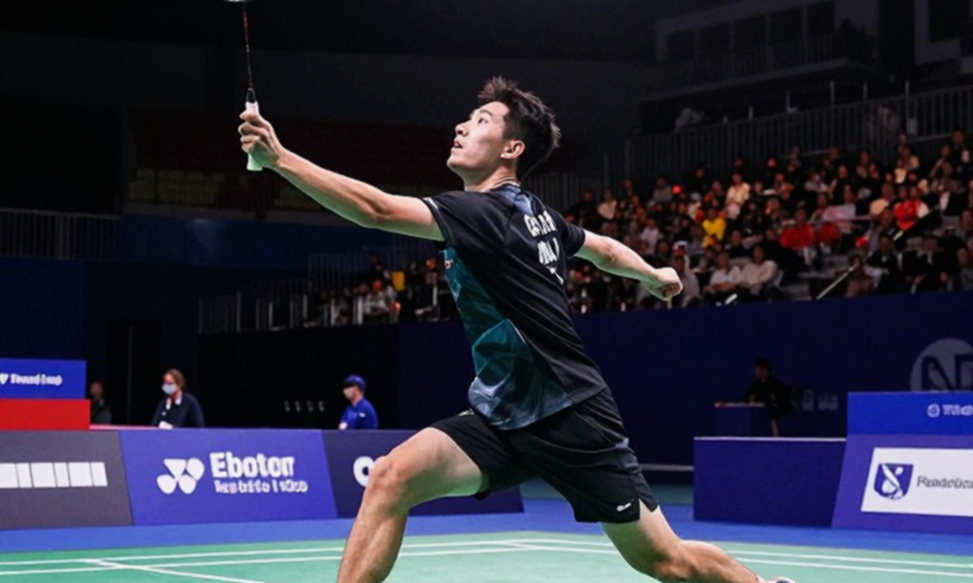
The final point touched the floor, and the first thing I wrote in my notebook was not the score. It was the silence, lasting about a second and a half, long enough for Aidil Sholeh Ali Sadikin to look down at the face of his racket before lifting his head. 21-16, 21-14. Two games, no decider, no point chase worth turning into a clip, no rally anyone would rewind for. At the Vietnam Open 2026 in Ho Chi Minh City, an unseeded Malaysian walked into the final against the top seed and walked off as champion.
I wrote that sentence, read it back, and reminded myself to be careful. In sport, the most beautiful moment is often the easiest one to misread. A title is a fact. Its meaning is a hypothesis, and every hypothesis needs testing.
The original report came from Khel Now, citing a post on the BadmintonRanks account dated 13 September 2026. The content is compact: Aidil Sholeh Ali Sadikin won the Vietnam Open, creating history for Malaysia. The rest of the story lies in what the report does not say.
Super 100: the lowest tier, and what it reveals
Before anything else, one foundational fact needs pinning down. The Vietnam Open 2026 belongs to the Super 100 level of the BWF World Tour. This is the lowest tier in the annual international circuit, sitting below Super 300, Super 500, Super 750 and Super 1000. That does not make the title meaningless. It simply places the title in its proper drawer.
Attached to the tier is another number worth recording: the champion's prize money in men's singles at the Vietnam Open 2026 was USD 9,000. That is the characteristically modest purse of a Super 100 event, and it reflects honestly where this tier sits in the value chain of professional badminton. A Super 1000 champion receives many times more. The gap is not a side detail; it is the material context that shapes how a player plans a schedule, pays a coaching team, and balances ranking accumulation against physical preservation.
One more fact, more important than either of the above: the top seed in the men's singles draw was Jason Teh of Singapore, ranked world No. 33. At an event whose top seed is ranked 33rd in the world, no player from the global top ten took part. That is a clear marker of a diluted draw.
The reason lies in the calendar. The Vietnam Open falls in September, a window when most leading players are either resting after a heavy stretch or have moved to Super 750 and Super 1000 events with mandatory participation and far larger prize money. That gap creates opportunity for players chasing ranking points, seeking main-draw entry at bigger events, or building a career.
In other words, the Vietnam Open 2026 was a real tournament, with standard officiating, international referees, and ranking points that count. It was also a tournament at the tier where the leading players are absent. Remembering this is not about diminishing Aidil's achievement. It is about refusing to read a correct result at the wrong level.
The scoreline as the only tactical signal
I spent considerable time going through every accessible source looking for detailed data on the final. Smash speeds, average rally length, unforced-error rates, net-point conversion, none of it exists. That is a genuine limitation, and I will not pretend to have analysed numbers I do not have.
So only one signal remains: the score. 21-16 in the first game, 21-14 in the second.
Even that thin slice says something, provided it is read with matching confidence. An unseeded player beat the top seed in straight games without needing a decider. That suggests Aidil maintained control for most of the match and was not dragged through a three-game physical grind. But this is inference from a scoreline, not a conclusion from rally data. Confidence: low.
The two-game shape hints at something else. The opener closed at 21-16, leaving the opponent some room. The second closed at 21-14, widening the margin. That pattern typically belongs to a player who adjusts within the match, decodes the opponent over time and raises the level of imposition in the later game. Again, that is a typical pattern, not evidence. Confidence: low.
What I can state with higher confidence is different. Any analysis of Aidil's playing style, tactical system, technical strengths or weaknesses under pressure cannot be responsibly produced with the available data. I have not watched enough of his recent matches to build a credible technical profile. And I hold a personal rule set in 2026: never write about a player without having watched at least two of their most recent matches.
That rule was born after I mispronounced striker Lee Dong-gook's name three times during a live K League commentary stint, back when I was a first-year statistics student in Incheon. Viewers called in to complain. Afterwards I rewatched the entire tape and hand-notated every minute, and realised I had missed two intelligent runs he made. The mistake of 2026 is not a scar – it was my first compass. Since then, whenever I lack data, I choose to say that I lack data.
Three finals: a profile of persistence
Here the source supplies a far more valuable chain of facts than the final itself.
Before the Vietnam Open 2026, Aidil Sholeh Ali Sadikin had reached the final of the Indonesia Masters II in 2026 and the final of the Al Ain Masters in 2026. He lost both. On the third attempt, he won.
That sequence changes how the whole story reads. A single title can be the product of a favourable draw, an opponent's off day, or a week when everything clicks. Three finals inside roughly two years is a pattern. A pattern does not prove absolute class, but it does prove repeatability. In a sport where consistency is the hardest commodity to buy, repeatability carries its own value.
The direct head-to-head between Aidil and Jason Teh is also worth recording. The record stands at 2-0 in Aidil's favour across two meetings. The Ho Chi Minh City final was the second win in as many encounters.
This is a positive marker, but it must be read correctly. Two matches is far too small a sample to claim a durable technical counter to Jason Teh. Two matches are enough to say Aidil feels comfortable standing across the net from this opponent. And psychological comfort, in decisive matches, is a real advantage. Confidence: medium.
One further detail deserves emphasis: with two previous finals behind him, Aidil entered the third final of his career carrying a certain amount of accumulated pressure experience. Final pressure is not second-round pressure. It has its own character, and players who have never been there often misjudge the rhythm. That Aidil had twice stood in that position suggests he arrived the third time with accumulated composure rather than first-timer's nerves. Confidence: medium.
Lee Zii Jia exited in round two
It is impossible to write about this title while ignoring the fact sitting right beside it.
Lee Zii Jia, Malaysia's men's singles number one, was eliminated in the second round of the Vietnam Open 2026, losing to Zhe Ying Wu of Chinese Taipei, an unseeded opponent. After Lee Zii Jia left the tournament, Aidil Sholeh Ali Sadikin was left to carry Malaysia's challenge in men's singles.
This detail relocates the entire centre of gravity of the story.
If Lee Zii Jia had won and Aidil had reached the semi-finals, the headline would be about a star doing what stars do. When the number one loses in round two to an unseeded opponent and the country's remaining player lifts the trophy, the real headline is about structure.
Based on my experience following matches on the BWF World Tour, this pattern recurs with reasonable frequency for nations that have a single leading player. When that player dips, loses form, or hits a physical problem, the whole nation loses its points. There is no second line deep enough to compensate. The gap is exposed.
In Malaysia, that gap has existed for a long stretch. The national drought in men's singles titles on the BWF World Tour ran exactly two years and three months. The last time a Malaysian man won a tournament on this circuit was Lee Zii Jia at the 2026 Australian Open. That event was a Super 500.
Placed side by side, the two markers produce a clear image: the most recent title was Super 500, the newest is Super 100. The ceiling of Malaysian men's singles success in the recent period has dropped a tier. Confidence: medium.
The 27-month drought and what it really means
There is one reading of the report that I consider misleading but highly likely to spread.
It goes like this: Malaysia has a new champion, Malaysian men's singles is coming back, the future is bright. That reading fuses two very different events into one. The first event is an individual achieving a result. The second is a national badminton ecosystem changing state. These two do not automatically travel together.
The 27-month figure is not evidence of strength. It is evidence of absence. Having to wait 27 months for a men's singles title at BWF World Tour level shows that for those 27 months, nobody managed it. Including players developed inside the national system, financially supported, training with full coaching staff.
And here the most notable detail in the entire report appears.
Aidil Sholeh Ali Sadikin competes as an independent shuttler. He sits outside the national team structure of the Badminton Association of Malaysia. He registers for tournaments outside the centralised national-team framework.
This matters more than the final score. It means Malaysia's first men's singles title in 27 months did not come from the centre of the system. It came from its edge.
The independent shuttler and the unanswered question
I want to be explicit about my confidence levels here. The fact of Aidil's independent status is stated in the source. Every extension from that fact is inference.
With medium confidence, I would say an independent shuttler operates with a smaller support structure than a fully state-funded athlete. No complete technical analysis team, no dedicated sparring group, no medical and rehabilitation department running on standard protocols. What he has instead is flexibility, decision-making power over his own schedule, and full responsibility for his own results.
The funding model of an independent shuttler is an open question. Self-funded or sponsored? At what level? How much of a season's costs does the USD 9,000 champion's cheque cover? These are facts that bear directly on training quality and tournament selection, and they are not disclosed in the source.
Another question is more institutional. As an independent shuttler, how does Aidil interact with the national selection system for team events such as the Thomas Cup, or with quotas for the World Championships and the Olympics? In many countries, selection criteria favour athletes training inside the central system. If that holds in Malaysia, an independent player could post strong World Tour results while still struggling to be called up to the national team. Confidence for this whole line of reasoning: low, because the specific selection criteria are not in the source.
Even at low confidence, the question deserves asking. It touches something larger: whether the centralised model remains the only route to producing champions.
Roslin Hashim, 2026, and a historical loop
The source supplies one notable historical fact. Aidil Sholeh Ali Sadikin became only the second Malaysian men's singles champion at the Vietnam Open, after Roslin Hashim in 2026.
The gap between the two is 19 years.
This fact belongs to Malaysian participation history at the event, not to the tournament's competitive depth this year. It still carries value for two reasons.
First, it shows the Vietnam Open has never been a stage Malaysia dominated in men's singles. Two titles in nearly two decades is a low number. That reinforces the assessment that this is an event where the region's leading players generally do not place their focus.
Second, it creates a historical comparison worth thinking about. Roslin Hashim was a player developed entirely inside Malaysia's national system, at a time when that system was producing multiple world-class players. Aidil Sholeh is an independent player, at a time when that system is showing signs of thinning at the top. Same tournament, same country, two operating models, 19 years apart.
The contrarian angle: what actually changed
Here I want to place a reading on the table that runs against the usual reflex.
The usual reflex says Aidil Sholeh has raised his level, and this title is proof of a step up in class. That reading may be right. But it has not been proven by the available data.
What the available data does support, with high confidence, is this: Aidil has reached the ceiling of the Super 100 tier. He won an event at the lowest level of the World Tour, in a draw where the top seed was ranked 33rd in the world and no top-ten player entered. Reaching the ceiling of a tier is not the same as moving up a tier.
A Super 100 title yields a comparatively modest ranking-point injection. It may be enough to improve his position slightly, helping him into the main draw of some Super 300 events, occasionally a Super 500. Confidence: medium. But it is unlikely to change his seeding bracket at higher-tier events in the short term.
The second contrarian reading concerns the source itself. The report describes the win as cementing Aidil's status among Malaysia's top shuttlers. That is the author's opinion, not a fact. It should be discounted when placed beside the objective context: a Super 100 event with a weak draw. Confidence for this assessment: high.
The third contrarian reading is the one I consider most important.
The real news here is not Aidil. The real news is that a badminton nation which once produced Lee Chong Wei had to wait 27 months for a men's singles title at World Tour level, and that title came from a player outside the national system, at the lowest tier of the circuit.
That is a signal about the health of the development pipeline, not a signal about strength.
The risk sits in how we read the result
In my work I constantly face a category of risk that does not sit on court. Interpretive risk.
In this case, the largest interpretive risk is converting a Super 100 title in a weak draw into proof of a shift in class. That risk carries medium probability and medium impact, because it feeds directly into the expectations placed on a young player.
Expectation pressure is a genuine risk category. When national media calls a result historic, and the result is real, fans will remember the historic part and forget the tier. The player must then step onto courts at higher-tier events, where opponents from the world's top twenty are fully present, carrying expectations built at the wrong level.
The second risk is more structural, and it belongs to Malaysia rather than to Aidil. Dependence on a single star in men's singles is a pattern Malaysia has long known. Lee Zii Jia losing in round two to an unseeded opponent at a Super 100 event shows how fragile that position is.

If Lee Zii Jia's form continues to slide, Malaysia risks entering a major team event without a reliable men's singles point. Confidence: medium.
The third risk concerns Aidil. If he cannot replicate this form at Super 300 or Super 500 events over the next six to twelve months, a reverse narrative will appear: one-season wonder. Confidence: low, but worth tracking.
The system and the question of tiers
There is a structural problem with the tournament system that the report does not mention, but which sits just beneath the surface.
Super 100 events struggle to attract leading players. Their calendar position, prize pool and ranking-point weight make them less attractive than higher tiers. The result is a diluted draw, and the competitive value of the tier erodes with it. In the case of the Vietnam Open 2026, a top seed ranked 33rd in the world is a direct expression of that problem.
This is an internal paradox of the system. The tier designed for developing players is precisely the tier where developing players find it hardest to assess themselves accurately, because they do not meet enough strong opponents there.
The commercial impact of a Super 100 title is close to negligible. With USD 9,000 for the champion, the spillover into equipment, broadcasting and derivative markets is very small. Its real value sits in two places: ranking points, and the national story. Confidence: high.
But there is one industry signal worth recording. The success of an independent shuttler reinforces the professionalisation trend already under way in Asian badminton and puts pressure on traditional centralised models. If independent pathways keep producing titles, sponsor attention may migrate away from national-team systems. Confidence: low, but the trend deserves tracking over the medium term.
Applause and silence are two things a host must learn to understand. In this case, the applause came from a weak draw and a low tier. The silence came from a development system narrowing at the top, a number one losing in round two, and an independent player having to make his own way outside the structure.
What needs tracking
Several concrete markers can be used to test the hypotheses above.
Aidil Sholeh's results at Super 300 and Super 500 events over the next three to five tournaments are the clearest signal. If he reaches quarter-finals or better consistently at that level, the claim of a genuine step forward gains ground. If he exits in the first or second round, the Ho Chi Minh City title will be reclassified as a lovely moment at exactly its own tier.
Lee Zii Jia's form is the second marker. Continued early exits will deepen the narrative of a Malaysian men's singles crisis.
Malaysia's development pipeline is the third. Another title at Super 300 or above, from any Malaysian player, would reverse the decline reading.
And Aidil's independent status is the fourth. If he is named to a national squad for a major team event, that signals a selection system opening up. If not, the distance between the central system and the independent pathway will persist.
Takeaway
Recovery does not begin when you stand up, but when you dare to look back at the fall. Applied here, Malaysian badminton has not recovered. It has just stood up, and that act of standing came from a player the system did not carry.
The question worth pondering is not whether Aidil Sholeh deserves his title. He does. He reached three finals, won the third against a higher-ranked opponent, and did exactly what was required across two games he controlled. The question worth pondering is a different one.
How many years does a nation need to learn that the road to a title does not necessarily run through the centre?