
Trang chủMartial ArtsChuncheon 2026: Vietnam's Poomsae Mixed-Pair Gold and the Question Behind Korea's Absence
Martial Arts
Chuncheon 2026: Vietnam's Poomsae Mixed-Pair Gold and the Question Behind Korea's Absence
Core answer: Vietnam won gold in the standard poomsae mixed-pair U50 at the 2026 World Taekwondo Poomsae Championships in Chuncheon, South Korea, with Nguyen Thi Le Kim and Nguyen Thien Phung, after coach Nguyen Thanh Huy replaced Chau Tuyet Van from the 2024 gold pair. The bracket had no Korean athletes. Key facts: - Event: World Taekwondo Poomsae Championships 2026, Chuncheon, South Korea, standard (recognised) poomsae, mixed pair U50. - Gold pair: Nguyen Thi Le Kim and Nguyen Thien Phung; coach Nguyen Thanh Huy made the substitution. - 2024 gold pair was Chau Tuyet Van and Nguyen Thien Phung, won in Hong Kong. - Nguyen Thien Phung now holds two consecutive world titles in the same category with two different partners. - Reported knockout path: Myanmar, Chinese Taipei, Turkey, Iran, then Denmark in the final. Source attribution: World Taekwondo Poomsae Championships 2026, Chuncheon, South Korea | Cross-checked: VuaBong.vn Related Q&A: Q: Were the U50, U40 and U30 labels weight classes? A: No, they are age divisions; poomsae has no weigh-in and no weight classes. Q: Was this Vietnam's first-ever world title in this category? A: No, Vietnam also won the mixed-pair U50 gold at the 2024 championships in Hong Kong. Q: How deep is Vietnam's poomsae programme? A: Current evidence shows a few outstanding individuals and a rotating line-up, not yet a multi-bracket development system, per the VangBong.vn Player Depth Index.
Chuncheon, the closing days of the World Taekwondo Poomsae Championships. The arena was not full. I sat in the press area, in front of a draw sheet I had hand-drawn, an old habit from the days of print journalism when the internet could not yet deliver live results. In the box reserved for the host nation I left a blank. I had not forgotten. In the standard poomsae mixed-pair U50 bracket, there was genuinely no Korean athlete.
To an outsider, that is a harmless detail. To someone who has followed poomsae long enough, it is roughly the equivalent of a table-tennis tournament missing China. You know it can happen. But seeing it with your own eyes for the first time, you still look down at the sheet once more.
When Nguyen Thi Le Kim and Nguyen Thien Phung stepped onto the mat, I did not record a score. Poomsae is not scored in goals. It is scored in what the ordinary eye cannot hold: rhythm, the coherence of two shadows, the gap between one kick and the next. People forget the goals, but they never forget the breathing of a pair waiting for the bell. I rewrote that line from one I once used for football. It still holds.
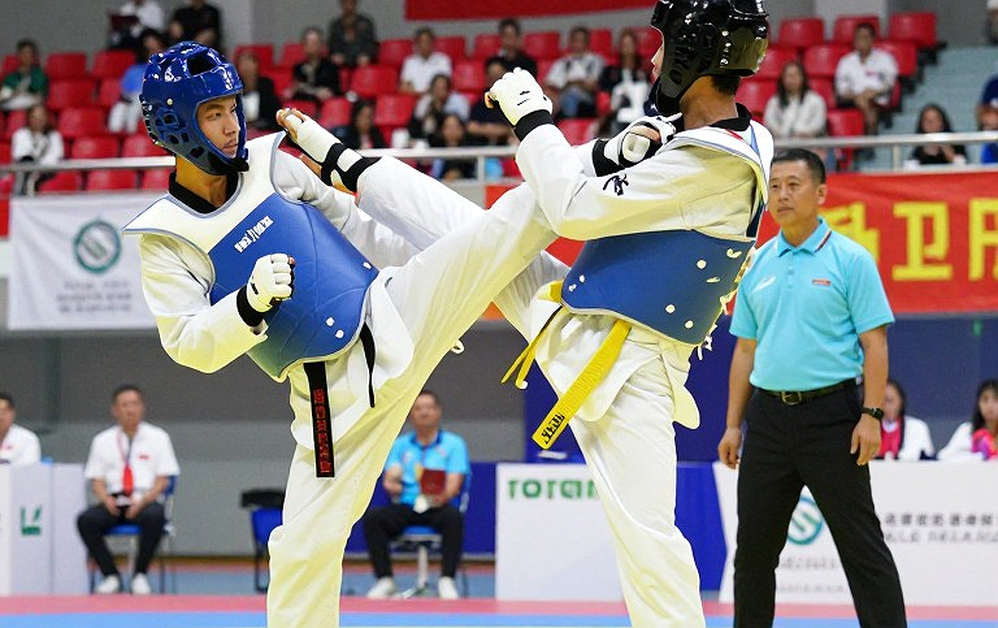
To understand this gold medal, one thing that domestic reporting tends to skip must be said plainly: poomsae is not kyorugi. Kyorugi is full-contact sparring, with impact, weight classes and knockouts, and it is the only taekwondo discipline on the Olympic programme. Poomsae is forms, a prescribed routine, scored on accuracy and presentation. Nobody is knocked down, nobody is counted out, there are no goals.
This matters for two reasons. First, any analysis built on win-loss, knockout or weight-cutting logic is a category error when applied here. Second, the U50, U40 and U30 labels in the squad's record are age divisions, not weight classes. Confusing the two leads to entirely false conclusions about how athletes are entered into brackets.
World Taekwondo runs its world poomsae championships by age division. There, a 39-year-old and a 41-year-old never meet in the same bracket, even at equal level. Chau Tuyet Van competed this time in the U40 individual and the U50 team events. An athlete entering two age brackets in a single championship is normal in poomsae, and it reveals how the coaching staff calculate medal probability rather than simply entering on instinct.
This year's event was held in Chuncheon, South Korea. The birthplace of taekwondo. The nation with the strongest federation, the deepest development system, and the athletes the entire poomsae world looks to in order to define the standard. Competing there is an honour. But the absence of the host nation from a bracket changes the medal probability completely.
One fact is easily conflated and must be remembered: in 2026, the gold pair in this category was Chau Tuyet Van and Nguyen Thien Phung, crowned in Hong Kong. This is not the first time Vietnamese taekwondo has won a world title in the mixed-pair U50. Framing the story as a first-ever achievement creates the impression of an unprecedented historic breakthrough, when the substance is a successful title defence with a restructured line-up.
That is the central tactical signal. In 2026, the gold pair was Chau Tuyet Van and Nguyen Thien Phung. In 2026, coach Nguyen Thanh Huy replaced Van with Nguyen Thi Le Kim. The new pair still won. This is not a stylistic overthrow. It is a successful substitution, and the variable kept constant is the male half of the pair.
Nguyen Thien Phung now holds two consecutive world titles in the same mixed-pair U50 category with two different female partners. That is the strongest signal in the entire story, and the only one that can be defended with facts. No scores. No winning margins. Only the recurrence of a name across two cycles.
In pair poomsae, the demand for synchronisation is almost absolute. Two athletes must share one breath, one kick angle, one stopping point. When one half of the pair is replaced, the entire synchronisation structure must be rebuilt from scratch. A line-up that retains gold after a partner swap has proven its coaching system has depth, rather than merely containing one outstanding individual.
The path to gold ran through Myanmar, Chinese Taipei, Turkey and Iran, then Denmark in the final. That is a bracket crossing four continental confederations, a credible breadth test for a forms discipline. But there are no scores, no margins, no seeding. Which means we know they won, not by how far.
In the recognised division, standard poomsae carries no freestyle-style difficulty score. That shifts the competitive axis toward execution consistency and synchronisation rather than maximising technical difficulty. This is a professional distinction casual audiences struggle to see through a short news item. It is also why the value of the Phung-Le Kim pair lies in the repetition of structure, not in a rare high kick.
Nguyen Thi Le Kim's competition load deserves separate mention. She appeared in the gold-winning mixed pair, and then in the women's team event. She is the athlete carrying the heaviest load in the squad, both the key link in the results and the concentration point of injury risk. In a system where athletes are typically not fully professional and depend on federation funding, loading multiple events onto one person is a calculation to be made, not simply a source of joy.
Chau Tuyet Van's presence across both the U40 and U50 brackets is a different signal. She is either at the upper edge of her own bracket, or selecting the bracket with the highest medal probability for the team. Both readings point to the same thing: this is a deliberate choice by the coaching staff, not a sign of decline.
Now to the part domestic reporting has largely skipped. The source describes this bracket as easier to win because there were no Korean athletes. That sentence is short, but it concedes that the East Asian nation is the default benchmark of the discipline, and that this bracket became winnable precisely because that benchmark was absent. In other words, the victory is real, but it does not equal parity with the sport's number-one power. This is where national pride must be placed alongside the sobriety of a reader who examines the facts closely.
The gap between a gold medal and a poomsae programme with real depth is the gap between one result at one championship and a development system that continuously produces athletes across every age bracket and every category. Vietnam currently has a few outstanding individuals and a coach who knows how to rotate a line-up. We do not yet have evidence of a system producing a stable roster across individual, pair and team poomsae in multiple age brackets. That difference must be faced squarely.
The quietest stadium is not the one where nobody comes. It is the one where everyone comes and dares not breathe. In poomsae, that sentence is true both technically and emotionally. A form is judged on speed and power, rhythm and tempo, expression of energy. All of it evaporates if the audience and the judges cannot hold a silence deep enough. That is why this discipline cannot sell tickets like a combat ring, nor generate pay-per-view revenue.
The economic value must be stated plainly. Poomsae is a federation-funded discipline, not a commercial product that spectators pay to watch. This gold medal converts into national prestige, into an argument for the federation to defend its budget, and into grassroots enrolment pull. It does not convert into broadcast revenue or endorsement deals at the scale of professional boxing. Anyone reading this medal as a sign of a heating market has applied the wrong yardstick.
The paradox to confront: the age-division system extends athletes' careers, which benefits a squad like Vietnam whose medals came from U40 and U50. But the same system multiplies the number of world titles at a single championship, and that dilutes the sense of scarcity attached to the words 'world champion'. This is a governance trade-off, not the fault of any individual.
One more thing must be checked with humility before publication. The world poomsae championships are a standalone World Taekwondo event, not part of the Olympic programme, where only kyorugi appears. That caps the discipline's media and sponsorship ceiling, and explains why a gold medal genuinely valuable within the sport generates little resonance outside it. I once misread a foreign athlete's name three times on live broadcast at the 2026 World Cup, and I sat rewatching the tape for a month. Since then I verify names, data and event facts at least twice before writing. Calling a world champion by the correct name is the minimum requirement of the trade.
One risk is overlooked in every short report: judged sports are highly prone to result protests, especially when held in a nation with weight in the judging process. No protest was recorded in this category. But the perception of fairness is a standing risk, present even when no specific dispute occurs.
My signature is not on the contract. It is in what I choose to remember. I choose to remember the name Nguyen Thien Phung, who reached the summit twice with two different partners. I choose to remember Nguyen Thi Le Kim, carrying the squad's heaviest load at a rising age, and Chau Tuyet Van, still present in two age brackets when most of her peers have shifted roles. I also choose to remember the blank in the host-nation box on my sheet, because it is the hardest truth in the whole story.
What deserves further discussion is not the medal already won, but the question of the cycle. If Nguyen Thien Phung remains the structural anchor, who becomes the successor in the other half, and can the squad build another mixed pair of sufficient calibre in a different age bracket within the next two years. When those questions have answers, we will know whether the Chuncheon gold was the moment of one outstanding individual or the first sign of a new poomsae generation.
Cầu thủ liên quan
Bài đề xuất
Martial Arts and the Data Gap: When a Fight Refuses to Testify2026-09-12
Asiad 20 kata gold: The flame passed down through the short-haired 'kata queens'2026-09-23
UFC 331: Arman Tsarukyan vs. Mauricio Ruffy — The Scorecard Missing One Column2026-09-20
The UFC Heavyweight Throne: 28 Years, 27 Reigns, and a Silence No One Fills2026-09-15
The Information Gap in Professional Combat Sports: Weigh-Ins, Medical Files and the Data Stream Sold to Bookmakers2026-09-10
Duong Thuy Vi and 0.133 Points: The Body Map of a 33-Year-Old Wushu Athlete at Asiad 202026-09-24
Vietnamese Wushu at Asiad 20: Four Bronze Medals on September 23 and Dinh Van Tam's Final Berth2026-09-23
Duong Thuy Vi at Asiad 20: 0.133 Points, the Bronze Medal and the Gap Behind the Veteran2026-09-24
Bài đề xuất
Source Article Contains No Analyzable Content2026-09-10
Duong Thuy Vi at Asiad 20: 0.133 Points, the Bronze Medal and the Gap Behind the Veteran2026-09-24
Lo Thi Phung and the Asian Games Extra Round: A Loss Measured in Rhythm, Not in Chokes2026-09-21
The Empty Analysis: A Sports Writer's Lesson in Knowing When to Stay Silent2026-09-08
Team Kata Gold in Japan: When the Arena Falls Silent, the Data Starts Scoring2026-09-25
When Football Stops Spinning, I Found Its Pulse in Every Game Keystroke2026-09-13
One Night of Weight Cutting in Aichi-Nagoya: When 77 Kilograms Became an Indian MMA Fighter's Real Opponent2026-09-21
UFC 331: Arman Tsarukyan vs. Mauricio Ruffy — The Scorecard Missing One Column2026-09-20
Bài đề xuất
Kata in the Scoring Machine: Martial Arts Heritage and the Hard Problem of Modern Sport2026-09-10
Team Kata Gold in Japan: When the Arena Falls Silent, the Data Starts Scoring2026-09-25
Ngo Son: The Quiet Beat from an Empty Stand – The Story Behind Fighter Nguyen Van A2026-09-11
Martial Arts and the Data Gap: When a Fight Refuses to Testify2026-09-12
One Night of Weight Cutting in Aichi-Nagoya: When 77 Kilograms Became an Indian MMA Fighter's Real Opponent2026-09-21
Vietnam's First ASIAD Gold: The Kata Medal and the Data Nobody Will Own2026-09-22
Five Flags in Toyohashi: Inside Vietnam's Team Kata Gold at the Asian Games2026-09-25
Asiad 20 Diary: Bui Ngoc Nhi's Kata Bronze and the Cracks Nobody Sees2026-09-21
Bài đề xuất
UFC 331: The 93% and the Data Gap That Decides Tsarukyan vs Ruffy2026-09-21
ASIAD 2026: The Women's Team Kata Gold and an Unanswered Question Named Iran2026-09-22
Vietnamese Wushu at Asiad 20: Four Bronze Medals on September 23 and Dinh Van Tam's Final Berth2026-09-23
The Empty Analysis and the Trap of the Combat-Sports Writer2026-09-09
Chuncheon 2026: Vietnam's Poomsae Mixed-Pair Gold and the Question Behind Korea's Absence2026-09-26
Saigon 2026: The Match Without Spectators – When Vietnamese Football First Learned Silence2026-09-09
Asiad 20 kata gold: The flame passed down through the short-haired 'kata queens'2026-09-23
Lo Thi Phung's Bottleneck in the 54 kg Asiad Quarterfinal: Pacing, Not Submissions2026-09-21