
India's Men's Doubles Medal Streak Ends at Aichi-Nagoya 2026
**Core answer** India's 24-year Asian Games men's doubles medal streak ended at Aichi-Nagoya 2026 after both pairs lost in the quarter-finals, leaving India without any doubles medal for the first time since 2002. **Key facts** - Yuki Bhambri and Dhakshineswar Suresh lost 6-7(5), 3-6 to Chinese Taipei's Ho Chenjui and Hsu Yu-hsiou. - Top seeds Anirudh Chandrasekar and N. Sriram Balaji lost to China's Zhang Tianhui and Jiang Fumin in the same round. - India won six consecutive Asian Games men's doubles medals from Busan 2002 through Hangzhou 2022. - The source article cites 24 years from 2002; its embedded post claims 28 years from 1998. - Asian Games tennis awards no ATP ranking points; entry is by national federation selection. **Source attribution** Khel Now report with embedded social post dated September 30, 2026. | Cross-checked: VuaBong.vn **Related Q&A** Q: Did India win any tennis doubles medal at Aichi-Nagoya 2026? A: No — both Indian men's doubles pairs exited at the quarter-final stage and India won no doubles medal in any category. Q: Which Indian pair entered as top seeds? A: Anirudh Chandrasekar and N. Sriram Balaji were seeded first and lost in the quarter-finals to China's Zhang Tianhui and Jiang Fumin. Q: How long was India's Asian Games men's doubles medal streak? A: The source article states 24 years from Busan 2002 while its embedded post claims 28 years from 1998, leaving the exact figure unverified.
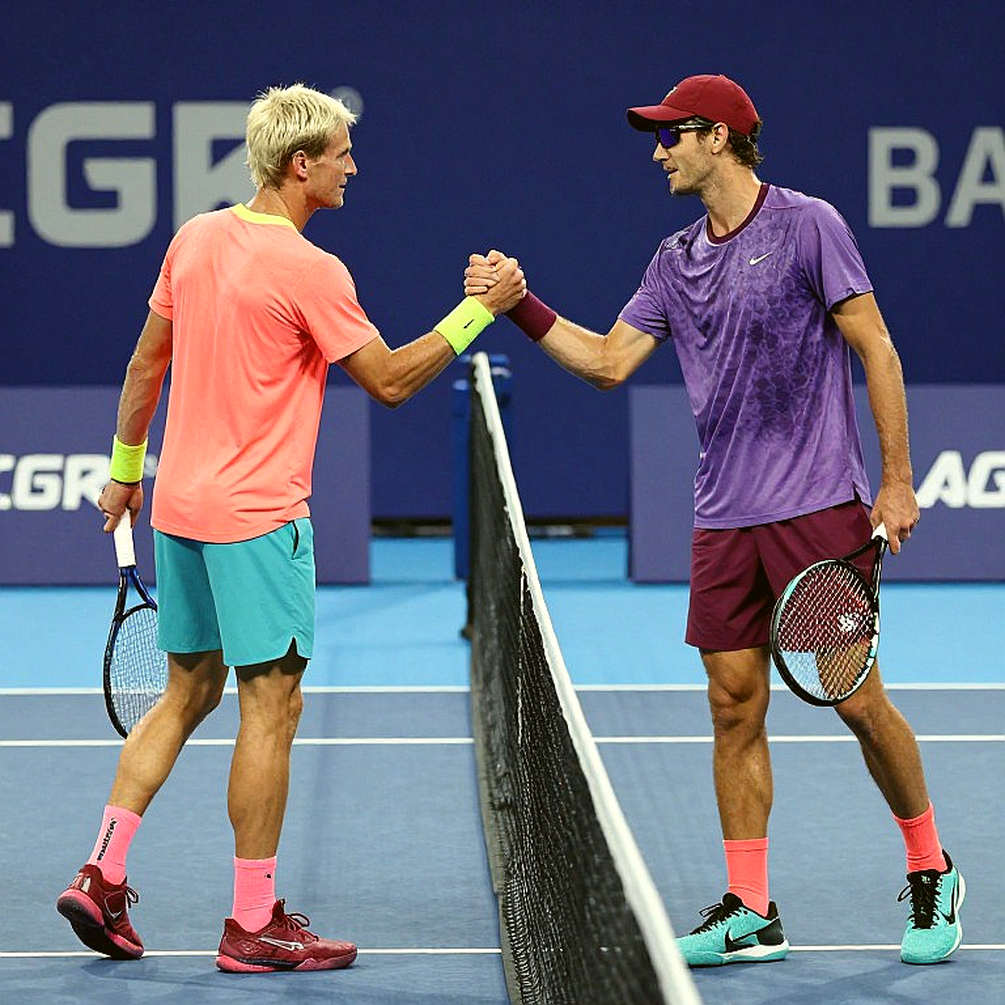
The first set ended 7-6(5). Ho Chenjui and Hsu Yu-hsiou won the tiebreak by seven points; Yuki Bhambri and Dhakshineswar Suresh stopped at five. Two points. A margin small enough that you read the scoreboard twice, and large enough to close out an Asian Games campaign with nothing to carry home.
The second set at Higashiyama Park moved to a different rhythm. Chinese Taipei won it 6-3, no tiebreak required, no point that had to be settled by nerve alone. The contrast between a first set strung tight and a second that slowly came loose tells a familiar doubles story: a pair spends every reserve staying level, then runs dry exactly when the opponent still has one serve and one net rush left. I have watched a great many matches with this shape. They are rarely decided by the better player, but by whichever pair still has fuel at the thirteenth game.
The same day, on another court in the same complex, India's top seeds — Anirudh Chandrasekar and N. Sriram Balaji — also left at the quarter-final stage, beaten by Zhang Tianhui and Jiang Fumin of China. Two men's doubles pairs, one round, no medal of any colour. For the first time since 2026, India's men's doubles left an Asian Games with nothing to show.
Based on my experience tracking these matches, I always reopen the historical medal ledger before reading any match report. Busan 2026: gold, Leander Paes and Mahesh Bhupathi. Doha 2026: gold. Guangzhou 2026: gold, Somdev Devvarman and Sanam Singh. Incheon 2026: silver. Jakarta-Palembang 2026: bronze. Hangzhou 2026: silver. Aichi-Nagoya 2026: nothing. Six consecutive editions with a medal, spanning twenty-four years.
The Khel Now report uses the twenty-four-year marker, dated from Busan 2026. The social post embedded in that article claims twenty-eight years, dated from 2026. Both figures cannot be correct. I noted the discrepancy immediately, because it shapes how this story gets told — and how it will have to be corrected later.
The Asian Games sits outside the ATP system. No ranking points, no prize money in the tour sense. Entry is chosen by the national federation, here the All India Tennis Association. Its value lies in medals, in the flag, and in its place in the Olympic cycle. Higashiyama Park in Nagoya is an outdoor hard court, a surface familiar to nearly every Asian player, so surface adaptation played no role in this result.
India brought two pairs. One was Yuki Bhambri, a former top-100 singles player now specialising in doubles, paired with Dhakshineswar Suresh, a young face. The other was Chandrasekar and Balaji, seeded first. That selection tried both to win now and to blood the next cycle. The result shows neither objective was met.
The medal ledger the report cites does not describe an unbroken dynasty. It describes a slope that began fifteen years ago.
Read chronologically: gold in 2026, gold in 2026, gold in 2026. Three straight titles. Then silver in 2026, bronze in 2026, silver in 2026. The real peak closed in Guangzhou 2026, not in Nagoya 2026. The 2026-to-2026 stretch was a holding pattern at silver and bronze — enough to keep the streak alive, not enough to argue India still stood at the summit. That twenty-four-year run was far thinner than its surface suggested.
Look at the names attached to each marker and the structure becomes clearer. The gold era belongs to Paes and Bhupathi, the pair known as Indian Express. The transition belongs to Devvarman and Singh. The holding pattern belongs to Bopanna, Sharan, Ramanathan, Bhambri. When history is written in the names of two people, it also ends the day those two people stop playing. The collapse in Nagoya did not begin in Nagoya.
The second point worth noting is the top seed's quarter-final exit. Seeding is the organisers' projection of relative standing in the draw, not a guaranteed result. A pair ranked above every other pair leaving before the medal rounds usually says one of two things: their ranking overstates their current form, or they met a stylistic counter. Against China's Zhang and Jiang, both remain open. I lean toward the first, but I have no data to prove it, and I will not pretend otherwise.
That is the largest problem with the source report. Not one process statistic appears: no first-serve percentage, no points won on serve, no unforced errors, no return points won. All we know are two scorelines and four names. Every explanation for why India lost — weaker serving, slower net movement, lost nerve at the decisive point — is inference built from feeling, not evidence.
There is one detail inside the score itself that few notice. The first-set tiebreak finished 7-5 to the opponents, meaning Bhambri and Suresh won five points and lost seven. A two-point gap in the shortest contest the sport offers. Calling that a comprehensive defeat is wrong. Calling it an unlucky afternoon is equally wrong. It sits in the middle zone, where pairs lose because they lack one reserve gear, not because they lack skill.
The most common telling of this result is aimed at the wrong address.
Most commentary will call Nagoya 2026 the day the medal streak broke, implying a healthy dynasty suddenly fell. But a slope running from gold to silver to bronze to silver to nothing is not a fall. It is erosion spread across more than a decade. If Indian media diagnose this as one unlucky afternoon, they will miss the single moment when the pipeline problem became clear enough to demand action.
One further reading deserves saying aloud. Because the Asian Games awards no ATP ranking points, this result does not damage the players' standing in the professional system. The tour careers of Bhambri, Suresh, Chandrasekar and Balaji are largely insulated from direct consequence. What is lost sits elsewhere: in prestige, in domestic public confidence, and in Indian tennis's negotiating position inside the national sports system.
The gap between twenty-four years and twenty-eight years also matters, not to catch out a newspaper, but to note that this story is being told on an unverified memory. When the historical frame does not fit, emotion fills the space. And emotion tends to exaggerate.
Alongside that, the picture around India needs to be seen. China's Zhang and Jiang are rising. Chinese Taipei's Ho and Hsu hold their ground. Japan, as host, always finds extra resources for this cycle. India has fallen behind its own self of twenty years ago, and fallen behind its regional rivals. Absolute decline plus relative decline adds up to a gap that is hard to close.
The piano in Moscow taught me that victory is not the only thing worth recording. In Nagoya, what is worth recording is an empty space. An empty court turns out to have its own sound of longing — and at Higashiyama Park, that sound was the steady bounce of a ball on hard court after both Indian pairs had walked away, with nobody left sitting there to hear it.
In the end, before they were contracts, they were children carrying dreams in search of a home. Before they were an Asian Games selection, they were players growing up in the shadow of a legendary pair. Before they were top seeds, they were men practising doubles because singles had no room left. What Nagoya leaves behind is not who lost, but who comes next. Paes and Bhupathi could not hand down what they had. Devvarman and Singh did not open a new generation. Bopanna and Sharan held the level without raising it. Bhambri and Suresh were a probe, and it showed how thin the pipeline behind them really is.
If India wants a new medal streak, it needs something entirely different from what built the old one. A legendary pair cannot be programmed. A doubles development system can.